
For small businesses, AI tools are saving time and money by automating repetitive tasks, reducing reliance on expensive services, and improving marketing results. Businesses adopting AI report saving up to $24,000 annually while freeing up resources to focus on growth. Here’s a quick look at how AI tools are helping:
- Visual Content Creation: Tools like PixelPanda replace costly designers with affordable AI-generated visuals.
- Content Writing: Jasper speeds up writing by 40%, cutting costs by up to 50%.
- Email Automation: Mailchimp boosts click rates by 115% with AI-driven campaigns.
- Ad Management: Adzooma optimizes ad spend with real-time adjustments.
- Customer Support: ManyChat reduces support costs with AI chatbots handling 70% of inquiries.
- Sales Optimization: HubSpot‘s AI automates lead scoring and saves hours on manual tasks.
- A/B Testing: Optimizely simplifies testing and improves campaign performance.
- Competitive Analysis: Crayon provides real-time market insights without expensive research.
- Energy Efficiency: Google AI tools cut costs by automating workflows and improving ad targeting.
- Workflow Automation: Zapier connects apps to eliminate manual tasks, saving up to 40% on marketing costs.
These tools are affordable, easy to use, and designed to help small businesses compete effectively without stretching budgets. Whether it’s creating visuals, automating emails, or managing ads, AI tools offer practical solutions to cut costs and achieve better results.
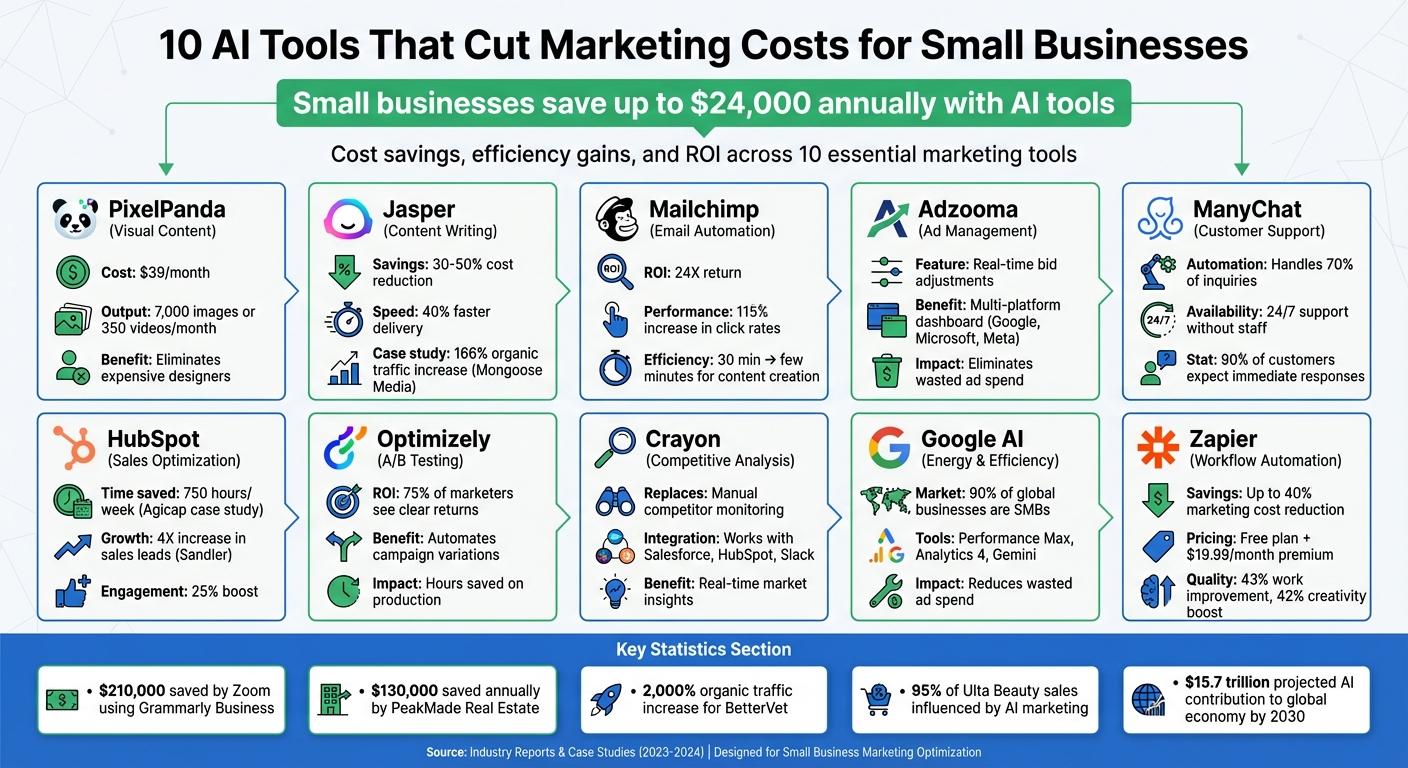
10 AI Tools That Cut Marketing Costs for Small Businesses – Cost Savings and ROI Comparison
1. PixelPanda: AI-Powered Visual Content Generation
Saving Money Without Sacrificing Quality
For small businesses, every dollar matters. PixelPanda steps in as a game-changer by reducing the need for pricey designers or stock photo subscriptions. With its $39/month Starter plan, businesses can create original visuals and videos from simple text prompts, slashing design expenses significantly.
On top of that, PixelPanda can churn out hundreds of ad variations in no time, making creative testing much more affordable. What used to be an advantage for companies with big budgets is now accessible to smaller businesses looking to optimize their marketing campaigns effectively.
Tailored for Small Business Marketing
PixelPanda delivers exactly what small businesses need for their marketing efforts: social media graphics, short-form videos, blog thumbnails, product photos, and even headshots – all without the hassle of a traditional photoshoot.
E-commerce businesses, in particular, can benefit from its AI fashion studio and product placement tools, which allow them to display products on virtual models or in realistic settings. Plus, with voiceovers in 35 languages and built-in commercial rights, the platform is ready to support global marketing efforts.
Simple to Use, Easy to Implement
PixelPanda is designed for ease of use, seamlessly integrating into existing workflows without requiring technical know-how or major system changes. Even those with minimal design experience can create professional-quality visuals thanks to its user-friendly interface.
For businesses just starting out, the platform offers a "start small" approach. The Starter plan includes enough credits – 7,000 images or 350 videos per month – to experiment and find what works best before committing to larger-scale use.
Next, we’ll dive into other AI tools that are helping small businesses streamline their workflows and cut costs.
2. Jasper: Automated Content Creation
Cost Savings Potential
Creating content can be expensive, but Jasper helps businesses cut those costs significantly – by as much as 30–50%. On top of that, it speeds up content delivery by about 40%. For companies that depend on regular blogs, social media posts, or ad copy, these savings can make a huge difference.
Take Mongoose Media as an example. By using Jasper, they reduced the time spent on writing a single blog post from 8–10 hours to just 2 hours. This efficiency helped them achieve a 166% increase in organic traffic. Similarly, Spinta Digital leveraged Jasper in a 90-day campaign to lower marketing costs by 38%, boost ROI by 2.6x, and improve lead quality by 42%.
Impact on Operational Efficiency
Jasper isn’t just about saving money – it’s about working smarter. It simplifies workflows for small teams by analyzing brand assets. With over 50 pre-built templates for tasks like blog outlines, product descriptions, social media captions, and video scripts, Jasper can generate drafts in mere minutes. It even integrates seamlessly with SEO tools like SurferSEO to optimize content in real-time.
Once you upload your business details, Jasper creates factually accurate, tailored copy for your products or services. Need to adjust the tone? You can do that with a single click. This streamlined process translates directly into better productivity for small business marketing.
Relevance to Small Business Marketing Needs
Small businesses often face the challenge of managing multiple marketing channels with limited resources. Jasper addresses this by not only reducing costs but also simplifying the content creation process. It’s versatile enough to handle emails, landing pages, ads, and social media content. Plus, with support for over 30 languages, Jasper enables businesses to expand into global markets without needing additional translation services.
The Creator plan starts at $39 per month (when billed annually), making it affordable for budget-conscious businesses. A 7-day free trial is also available, so you can try it out before making a commitment. Considering that 72% of businesses now utilize AI for marketing and sales, Jasper gives small businesses a chance to compete effectively.
Ease of Implementation
You don’t need to be tech-savvy to get started with Jasper. Its user-friendly dashboard makes it easy to upload your brand data and begin creating content. Most users treat Jasper as a starting point – it generates the first draft, which can then be polished by a human editor.
"AI tools now enable brands to produce high-quality, optimized content in a fraction of the time." – Spinta Digital
Start small by using Jasper for one type of content, and then expand its use as you grow more comfortable with the platform.
3. Mailchimp: Email and Social Media Automation

Cost Savings Potential
Mailchimp’s AI-powered automation delivers impressive results, offering up to 24X ROI and increasing email click rates by 115%. These numbers highlight the financial benefits Mailchimp brings to businesses.
One standout feature is Intuit Assist, which drafts, edits, and refines emails instantly. This tool eliminates the heavy reliance on professional copywriters. Jack Tadd, Managing Director at Warm Glass UK, shared how it transformed his team’s workflow, cutting content creation time from 30 minutes to just a few minutes.
"The copy is a perfect starting point, and making changes would take just a few minutes rather than taking half an hour. It’s like having that digital assistant that allows you to become an editor rather than a writer." – Jack Tadd, Managing Director, Warm Glass UK
Impact on Operational Efficiency
Mailchimp streamlines repetitive marketing tasks, allowing teams to focus on strategy rather than execution. Pre-built marketing flows like welcome sequences, abandoned cart recovery, and win-back campaigns are operational after a quick setup. Tools for optimizing send times and days analyze past engagement data to maximize delivery effectiveness.
With features like integrated content creation, audience segmentation, and analytics, Mailchimp empowers small teams to handle tasks that would otherwise consume significant time. This efficiency opens up opportunities to prioritize broader marketing strategies.
Relevance to Small Business Marketing Needs
Mailchimp democratizes advanced marketing tools, making features like predictive segmentation and personalized campaigns accessible to small businesses – capabilities that were once reserved for larger companies.
"AI as a service levels the playing field by giving small businesses access to sophisticated marketing capabilities that would otherwise be out of reach." – Mailchimp
The Standard Plan includes advanced automation and optimization tools, while Intuit Assist (currently in beta) is available at no extra cost for Premium, Standard, and Legacy users in select countries. A free trial lets businesses explore these features before committing, making it easier to assess its value.
Ease of Implementation
Mailchimp’s user-friendly design is perfect for small businesses. You can start with a single automated flow – like a welcome sequence or an abandoned cart reminder – and expand as you see results. The Write with AI feature simplifies content creation by generating first drafts, letting you refine your brand’s voice without starting from scratch. This balance of simplicity and functionality makes Mailchimp a practical choice for businesses looking to enhance their marketing efforts.
4. Adzooma: Analytics and Campaign Optimization

Cost Savings Potential
Adzooma helps businesses cut down on unnecessary expenses by leveraging AI to predict spending patterns more accurately. Instead of relying on trial-and-error methods, the platform uses automation and real-time data to adjust bids, ensuring you get the most out of your advertising budget. Its AI-powered tools analyze audience behavior and adjust campaigns accordingly. Additionally, Adzooma’s rule-based management system allows users to set custom rules – such as pausing underperforming ads or increasing budgets for high-performing ones – minimizing wasted spend and improving overall efficiency. This smarter spending approach simplifies daily campaign management.
Impact on Operational Efficiency
Adzooma doesn’t just save money – it saves time. For small marketing teams, juggling multiple platforms like Google Ads, Microsoft Ads, and Meta Ads (Facebook/Instagram) can be overwhelming. Adzooma consolidates all this data into one user-friendly dashboard, eliminating the hassle of switching between accounts. Its automated analytics provide real-time insights, cutting down the hours spent on manual reporting. Features like One-Click Optimizations analyze your account data and highlight actionable "Opportunities" to improve performance. From adjusting bids to reallocating budgets and refining targeting, these automated tools take care of repetitive tasks, freeing up more time for strategic decision-making.
Relevance to Small Business Marketing Needs
Adzooma’s predictive analytics are especially valuable for small businesses, helping them navigate the complexities of digital marketing with confidence. By forecasting campaign performance before significant spending occurs, the platform reduces financial risks and eliminates guesswork. It also automates multi-platform advertising, allowing business owners to focus on big-picture strategies rather than getting bogged down in spreadsheets and platform-specific dashboards. This AI-driven, streamlined approach empowers small businesses to compete effectively in the fast-paced world of digital marketing.
5. ManyChat: AI-Driven Customer Personalization
Cost Savings Potential
ManyChat’s AI chatbots take the hassle out of round-the-clock customer support. They can manage up to 70% of routine inquiries, automate lead follow-ups, and handle email nurturing – all without requiring a 24/7 support team. Considering that 90% of customers expect immediate responses to their service questions, this level of automation isn’t just a convenience – it’s a game-changer. It slashes costs while keeping your daily operations running smoothly.
Impact on Operational Efficiency
By analyzing customer data like website activity and purchase history, ManyChat creates personalized offers that drive higher click-through rates and conversions. These chatbots don’t just answer questions; they qualify leads, set up meetings, and handle repetitive tasks so your team can focus on more strategic work. For businesses juggling multiple time zones or catering to global audiences, the 24/7 availability ensures you never miss a potential customer. Plus, its intuitive setup makes it easy to integrate into your workflow.
Ease of Implementation
ManyChat keeps things simple with a no-code platform that lets small business owners build functional chatbots in no time. Its plain-text interface allows you to create AI agents capable of qualifying leads and scheduling appointments using natural language instructions. This means you can start automating customer interactions right away, without needing a developer or spending weeks learning complex systems. It’s automation made easy.
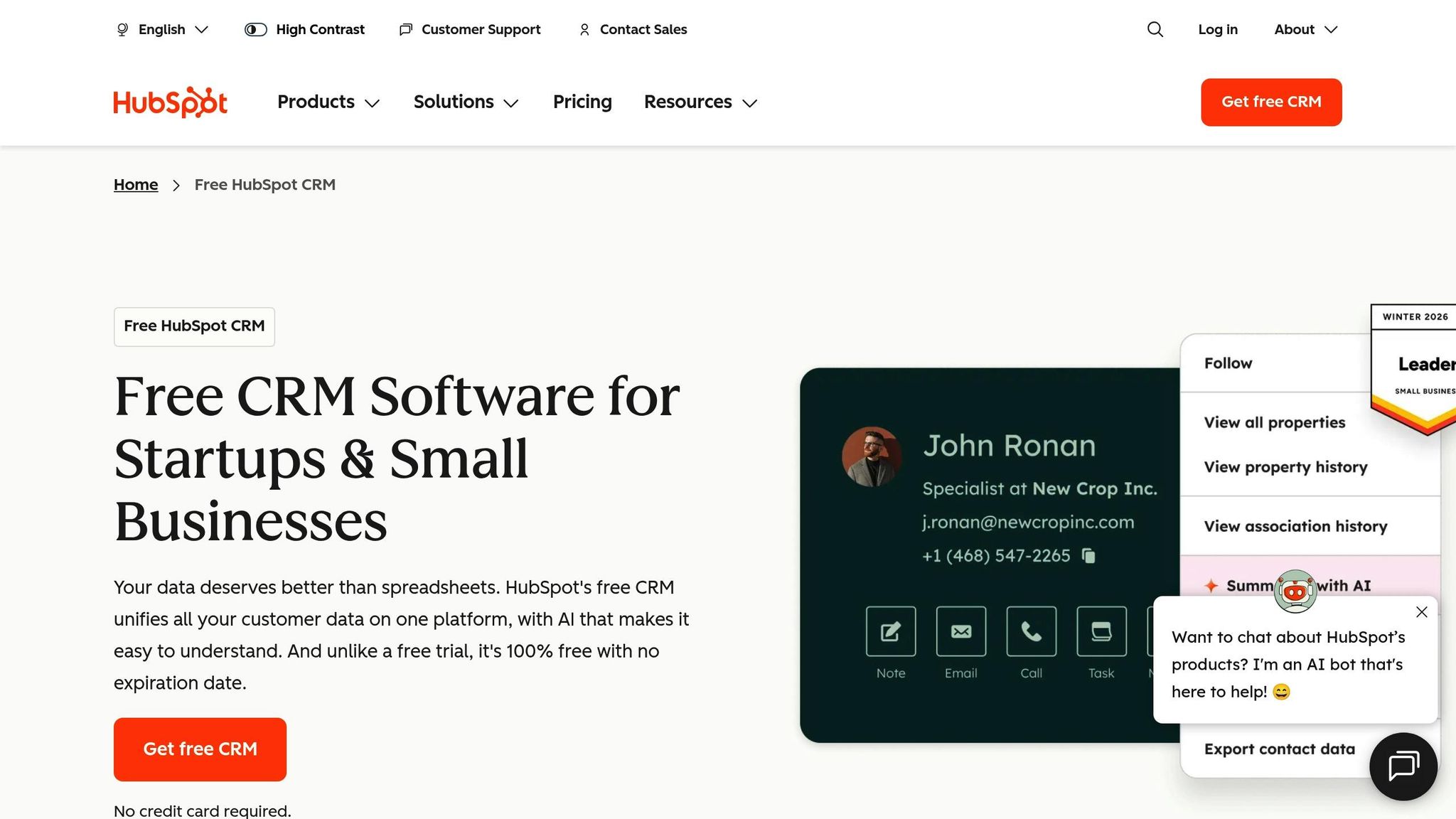
6. HubSpot: Automated Lead Scoring and Sales Optimization
Cost Savings Potential
HubSpot’s AI platform, called Breeze, streamlines lead management and reduces the need for extra staffing. With tools like the Breeze Prospecting Agent, it identifies buying signals and researches prospects, cutting out the need for additional sales development reps. For example, Agicap saved an impressive 750 hours per week and increased deal velocity by 20%. Similarly, Sandler experienced a 4× growth in sales leads and a 25% boost in engagement. Thanks to predictive lead scoring built into the CRM, sales teams can zero in on high-value prospects, avoiding time wasted on manual qualification.
Impact on Operational Efficiency
Breeze ensures your pipeline stays organized by deduplicating contacts and logging call notes automatically. It focuses on high-intent actions, such as website visits and form submissions, so your marketing budget targets the leads most likely to convert. Additional features, like the Email Content Assistant, draft polished outreach messages, while the Reporting Assistant creates instant data visualizations, making specialized data analysts unnecessary. Rachel Nicholson from HubSpot highlights the platform’s efficiency:
"Breeze takes the heavy lifting out of manual updates – from deduplicating contacts to capturing call notes – so your pipeline stays clean and your reps stay focused on revenue."
Ease of Implementation
HubSpot’s AI tools are designed to be user-friendly, even for non-technical users. The free CRM offers basic features for beginners, while paid Sales Hub plans start at $100 per month. The Breeze Studio allows customization of AI tools without requiring any coding skills, and it integrates effortlessly with your existing CRM data. For round-the-clock support, the AI Chatbot Builder can qualify leads and schedule meetings without the need for technical expertise. Small businesses looking for a straightforward solution can opt for HubSpot’s Starter Customer Platform, which bundles essential tools into one package. This setup lets you create lead capture forms and manage data storage in just minutes. Up next, discover how dynamic workflow automation can simplify your marketing even further.
sbb-itb-76ad1b7
7. Optimizely: Dynamic Content and A/B Testing
Cost Savings Potential
Optimizely’s AI-powered tools streamline the creation of multiple content variations – like email subject lines and ad copy – for A/B testing. This automation can drastically reduce production time. Recent studies show that 75% of marketers see a clear return on investment from AI, largely because it saves time on routine tasks. Leah Messenger, Content Marketing Manager at Optimizely, captures this sentiment perfectly:
"AI has real potential to supercharge how marketing teams work… from shaving hours off campaign production to automating the kind of low-value tasks that make your soul quietly leave your body."
By automating these processes, teams not only save money but also improve their overall campaign strategies.
Impact on Operational Efficiency
Optimizely processes performance data at lightning speed, allowing even small teams to quickly spot which campaigns are hitting the mark. The platform can also generate campaign briefs and meeting summaries automatically, eliminating the need for specialized analysts. By taking over repetitive tasks like data entry and content tagging, Optimizely frees up your team to focus on creative and strategic work.
Ease of Implementation
Thanks to streamlined performance data, integrating Optimizely into your workflow is a simple process. The platform suggests starting with easy, "quick-win" A/B testing scenarios to ease adoption. By keeping your existing tools and processes intact, you can avoid unnecessary complexity. And as Leah Messenger wisely notes:
"AI is only as good as the process it supports… and we’re here to help you build a damn good one."
Before diving into automation, small businesses should first review their current marketing workflows. Fixing inefficiencies early ensures that you’re not scaling flawed processes and helps you get the most out of your investment.
8. Crayon: Market Research and Competitive Analysis
Cost Savings Potential
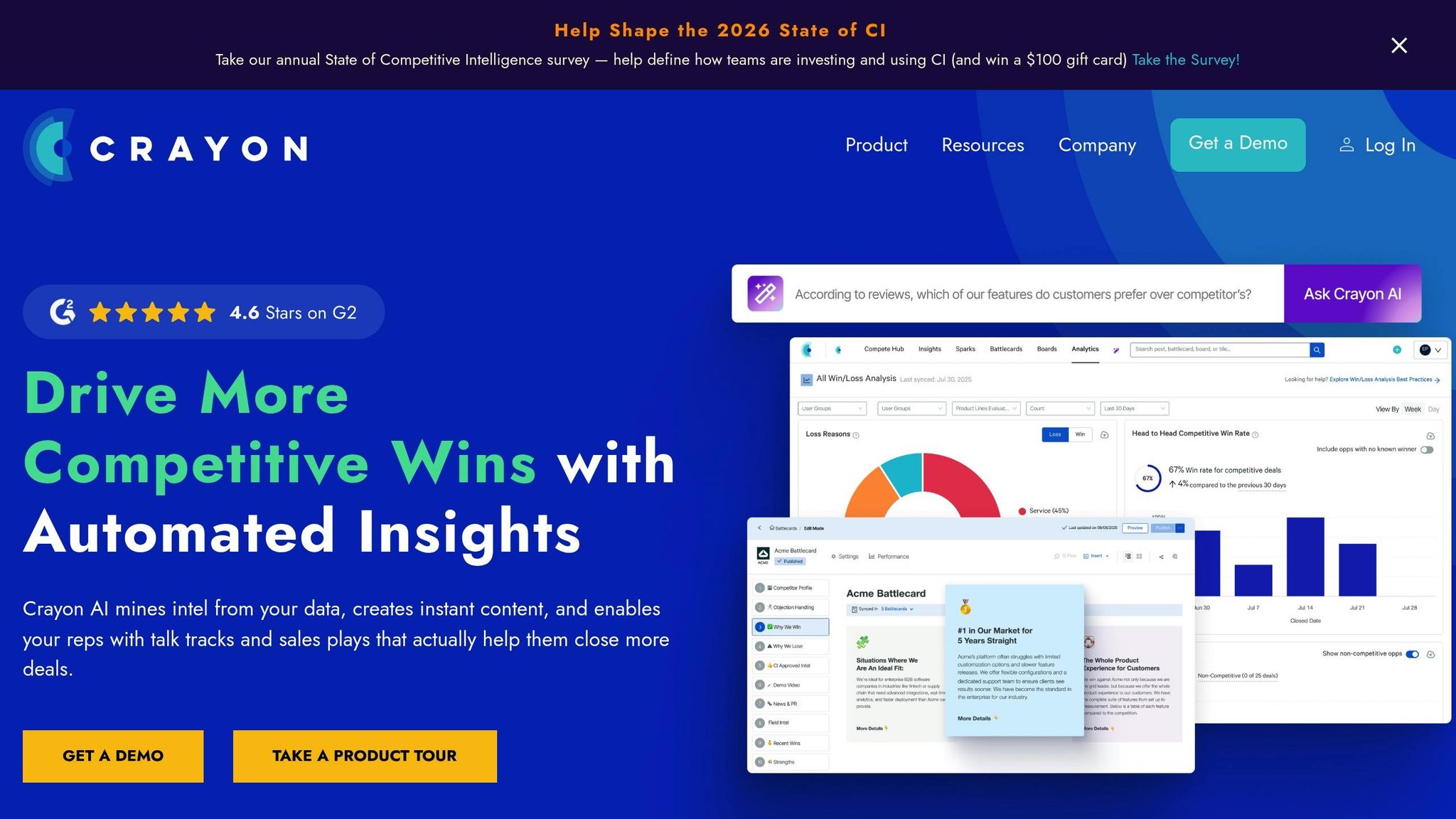
Market research can often feel like a luxury for small businesses – it’s costly, time-intensive, and resource-heavy. Crayon changes the game by leveraging AI to gather competitive intelligence from sources like websites, review platforms, and industry publications. This eliminates the need for manual monitoring, which is both expensive and time-consuming. For small businesses without the budget for dedicated research staff, Crayon delivers insights at a fraction of the cost. Its AI engine filters through competitor data and sends alerts only when something relevant pops up, cutting down on unnecessary noise and improving operational focus.
Impact on Operational Efficiency
Crayon acts like an extra set of hands for your marketing team, taking over the labor-intensive tasks of tracking competitors. It integrates seamlessly with tools you’re probably already using – like Salesforce, HubSpot, and Slack – so you won’t need to overhaul your workflow. Instead of spending hours manually tracking competitor updates, your team gets real-time alerts about critical changes, such as pricing adjustments, new product launches, or shifts in customer sentiment. This allows your team to spend more time making strategic decisions and less time buried in data collection.
Relevance to Small Business Marketing Needs
Small businesses often struggle to balance the need for competitive intelligence with limited resources to gather it. Crayon bridges this gap by providing timely insights that help maintain a competitive edge. Its dynamic sales battlecards, powered by a real-time feed of competitive data, give your sales and marketing teams an always-updated resource to identify gaps in competitors’ offerings. This enables you to adjust your positioning quickly, which can make a big difference when you’re operating on a tight budget.
Ease of Implementation
Crayon is built with simplicity in mind. It offers native integrations with popular small business tools, so you can hit the ground running without overhauling your systems. Start small by tracking your top competitors, then expand as needed. By syncing Crayon with your CRM, your sales team gains instant access to competitive insights during live deals. With automated monitoring replacing manual data collection, your team can focus on crafting marketing strategies that deliver results.
9. Google AI for Energy Optimization
Cost Savings Potential
Google AI tools are a game-changer for small businesses looking to cut costs. By automating labor-intensive tasks, these tools reduce the need for extra staff. For instance, Performance Max eliminates the guesswork in targeting high-value customers, saving time and money. Meanwhile, generative AI in Google Workspace allows businesses to produce more content without hiring additional team members using the best AI tools for marketing. The result? Lower labor expenses without sacrificing productivity, paving the way for smoother daily operations through AI marketing.
Impact on Operational Efficiency
Google AI tools, like Gemini in Workspace, are designed to help businesses "do more with less." They automate tasks such as organizing receipts, tracking project milestones, and summarizing lengthy documents. Features like Sheets’ "Help me organize" instantly generate tailored checklists and trackers, making tedious tasks a breeze. This frees up your team to focus on strategic planning and creative projects. Additionally, Google Analytics 4 leverages AI to provide predictive insights, giving even small businesses access to data-driven intelligence that rivals larger organizations.
Relevance to Small Business Marketing Needs
Google AI isn’t just about saving money and improving efficiency – it’s tailored to meet the core marketing challenges of small businesses. Small businesses make up 90% of all businesses worldwide and contribute to 50% of global GDP, so optimizing operations is critical. Selin Song, President of Google Customer Solutions, highlights this priority:
"Whenever I meet small- and medium-size business (SMBs) owners across the globe, they continue to ask, ‘How can I find and keep the right customers and help my business grow with measurable results?’"
By cutting down on wasted ad spend and streamlining labor, Google AI helps small businesses achieve cost-effective marketing results. It also identifies hidden inefficiencies, enabling smarter energy use and waste reduction – all without requiring major financial outlays.
Ease of Implementation
Getting started with Google AI is simple. Google provides free basic services and even offers an AI Essentials checklist to help you integrate these tools into your workflow. Start small – try upgrading to Google Analytics 4 to test its impact and value. And while AI can handle many tasks, maintaining human oversight ensures the decisions align with your brand’s vision and goals.
10. Zapier: Workflow Automation and Integration
Cost Savings Potential
Zapier simplifies operations by connecting thousands of marketing apps into one streamlined system, reducing the need for time-consuming manual tasks. For small businesses, this means creating tailored solutions – like lead management, landing pages, and AI chatbots – without the need to hire specialized IT staff. The platform also includes built-in tools such as a form builder, database (Tables), and chatbot creator, which can replace multiple standalone subscriptions. By incorporating AI-driven automation, businesses can cut marketing costs by up to 40%. With a free plan for basic needs and premium options starting at $19.99 per month (billed annually), Zapier offers an affordable solution for small enterprises looking to maximize their budgets.
Impact on Operational Efficiency
Zapier excels at automating repetitive tasks like managing editorial calendars, scoring leads, and data entry. Its "Copilot" feature allows users to create custom automations just by describing their workflow in plain English, while the visual "Canvas" tool helps map out complex processes to identify and eliminate bottlenecks. According to marketing professionals, AI tools improve work quality by 43% and enhance creativity by 42%. Bryant Chou, Co-Founder of Webflow, captures this advantage perfectly:
"It puts the tools into the hands of people who understand a task and lets them completely automate it away."
Relevance to Small Business Marketing Needs
For small businesses, automation can be a game-changer, especially when 25–30% of ad budgets are often wasted on underperforming campaigns. With 74% of marketers using AI to automate repetitive tasks and improve personalization, Zapier bridges the gap by connecting platforms like HubSpot, Slack, and Mailchimp – no technical expertise required. Its "Agents" feature can autonomously handle tasks like generating weekly campaign reports or managing lead engagement across multiple apps, allowing teams to achieve more without increasing payroll expenses.
Ease of Implementation
Zapier’s no-code design makes it incredibly easy to integrate into existing workflows. You can start with pre-made templates – such as linking Google Forms to your CRM – and see results almost immediately. The platform’s drag-and-drop "Canvas" editor simplifies workflow design, eliminating the need for programming skills. A smart approach is to begin by automating a high-effort, low-return task, like lead qualification or email scheduling, to quickly boost efficiency. Plus, with "AI by Zapier", you can add AI functionality to any workflow step, even if your connected tools lack native AI capabilities.
How To Use AI to Start, Build & Grow Your Small Business (20 AI Marketing Tools!)
Conclusion
AI tools have become a game-changer for small businesses, offering solutions that save time, reduce costs, and improve efficiency. Today, marketers are heavily relying on AI marketing tools, and businesses that adopt these tools are gaining an edge over their competitors. Whether it’s creating visual content or automating workflows, AI is simplifying operations while keeping expenses in check. The examples shared earlier highlight how these tools can lead to practical and impactful strategies across digital marketing.
The numbers speak volumes. For instance, Zoom cut communication costs by $210,000 using Grammarly Business, while PeakMade Real Estate saved $130,000 annually by speeding up content creation. BetterVet saw an astonishing 2,000% increase in organic traffic thanks to AI-powered SEO tools. Meanwhile, Ulta Beauty’s personalized, AI-driven marketing influenced a staggering 95% of their sales. These success stories show how small businesses can achieve big results by working smarter with AI.
"AI allows small business owners to concentrate on achieving results rather than worrying about the work required." – Abílio Rodrigues, Content Editor, Pipedrive
If you’re just starting, pick one repetitive task – like scheduling emails – and try an AI tool designed for that. Many platforms offer free trials or basic plans, making it easy to test their value and track ROI before committing to larger investments.
While the immediate benefits of AI are clear, its long-term potential is even more exciting. With AI projected to contribute $15.7 trillion to the global economy by 2030, there’s no shortage of opportunities. The real question is: which tool will you try first to see fast results?
FAQs
How can AI tools help small businesses reduce marketing costs?
AI tools are a game-changer for small businesses looking to cut marketing costs. By automating tasks like content creation, managing email campaigns, and handling social media, these tools free up valuable time and resources. Plus, with data-driven insights, they fine-tune targeting so your ads reach the right audience, cutting down on wasted ad spend.
On top of that, AI-powered analytics offer real-time performance tracking. This means you can quickly tweak your strategies to avoid ineffective approaches. The blend of automation and precision allows small businesses to get more done with fewer resources, making marketing both efficient and impactful.
What are some AI tools small businesses can use to improve marketing efficiency?
AI tools offer small businesses a way to save both time and money while achieving better marketing outcomes. For instance, AI-driven content creation platforms can quickly produce blogs, social media posts, and ad copy, helping businesses maintain a consistent online presence. Similarly, social media scheduling tools automate posting and engagement, freeing up time for other tasks. Meanwhile, email automation software customizes campaigns, making it easier to connect with customers on a more personal level.
Other useful tools include analytics platforms that leverage data insights to refine marketing strategies and AI-powered chatbots that deliver instant customer support, enhancing response times and customer satisfaction. By simplifying workflows and improving efficiency, these tools are a smart choice for small businesses working within tight budgets.
How can small businesses start using AI tools without technical skills?
Small businesses can now dive into the world of AI without needing any technical background, thanks to no-code platforms. These platforms come with pre-built templates and easy-to-follow workflows, making it simple to get started. For instance, you can create social media posts, draft email content, or even generate ad headlines just by typing in a short prompt. The best part? You’ll get results in minutes – no coding required.
A smart way to begin is by applying AI to a single, repetitive task. Think of something like drafting blog outlines, segmenting email lists, or scheduling social media posts. Most tools are designed with beginners in mind, offering tutorials, searchable guides, and active user forums full of practical advice. By following these resources, you can quickly learn the ropes and see real results. Once you’re comfortable, you can gradually expand into more advanced areas, such as building analytics dashboards or creating personalized recommendations for your customers.
To ease into it, take advantage of free trials and freemium plans. Many AI platforms allow you to test their features with no upfront investment, offering free usage limits each month. This way, you can evaluate their value before deciding to upgrade to a paid plan. By sticking to user-friendly, no-code tools and starting with simple, manageable tasks, small businesses can tap into the benefits of AI without needing any technical expertise.