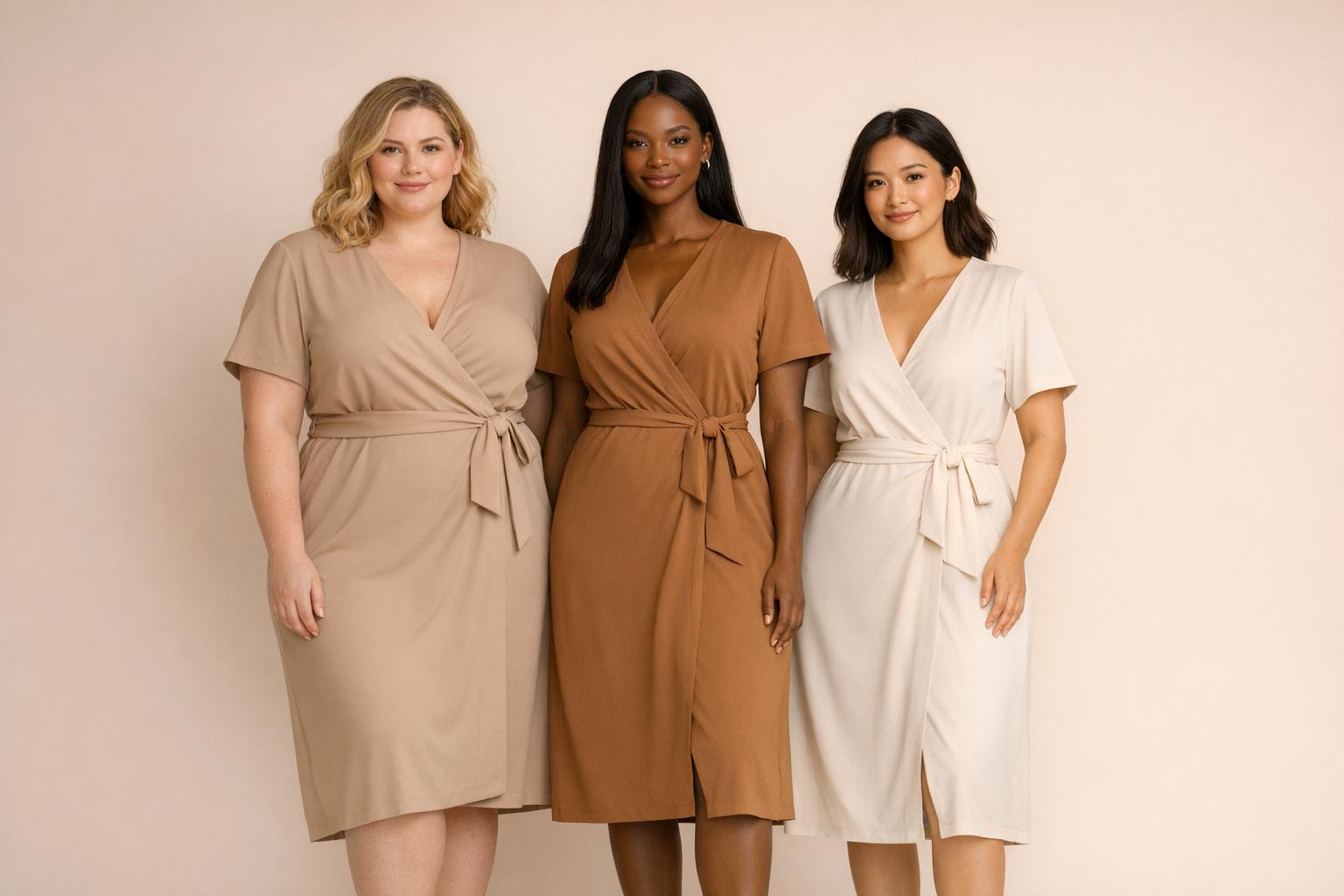
AI fashion models are transforming online shopping by addressing a major issue: 42% of shoppers feel unrepresented by traditional e-commerce models, and 59% have faced disappointment when items didn’t match their expectations. These digital avatars simulate various body types, skin tones, and fabric behaviors using advanced AI, improving how clothing is showcased online.
Key takeaways:
- Better fit visualization: AI simulates how fabrics drape and move on different body types, reducing returns (20% of U.S. online purchases were returned in 2022).
- Cost and time savings: AI reduces production costs by up to 90% and speeds up content creation from weeks to days.
- Tools like PixelPanda: Offers features like customizable avatars, virtual try-ons, and batch processing for e-commerce brands, starting at $39/month.
From enhancing product photos to creating diverse marketing campaigns, AI fashion models are reshaping how brands connect with shoppers while cutting costs and improving accuracy.
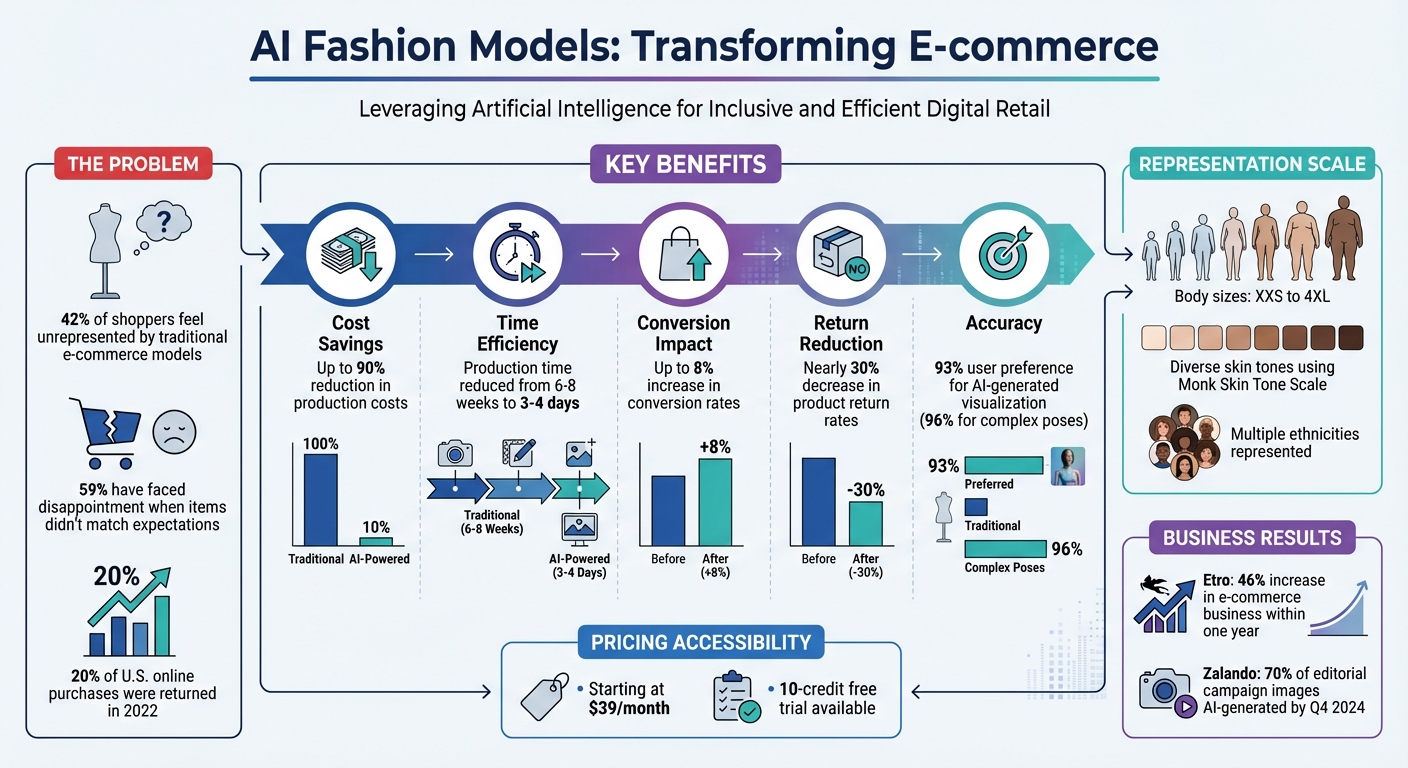
AI Fashion Models Impact on E-commerce: Key Statistics and Benefits
Create AI MODEL & try on clothes! | AI E-Commerce Photoshoot for Clothing Brands
PixelPanda‘s AI Tools for Diverse E-commerce Visuals

PixelPanda is a cloud-based photo studio that brings together all the key tools needed for e-commerce visuals – background removal, 4× upscaling, generative fill, and an AI avatar studio – into one streamlined workflow. With batch processing capabilities, it allows brands to update entire product catalogs quickly and efficiently. Thanks to its API-first design, PixelPanda makes it easy to create lifelike and inclusive visual content, helping brands represent a wide range of audiences.
Getting started is simple: the platform offers a 10-credit free trial with no credit card required. Subscription plans begin at $39 per month (billed annually) under the Starter plan. For larger-scale operations, the credit-based system supports higher volumes, though credits must be used within the same month as they do not roll over.
Customizable Avatars for Inclusive Representation
PixelPanda’s AI Avatar Studio creates virtual try-on models that reflect a variety of body shapes and ethnic backgrounds, eliminating the need for costly and time-consuming physical photoshoots. This feature addresses a common gap in representation, ensuring garments are displayed naturally on different body types. With the AI Try-On tool, brands can demonstrate how their clothing fits across a diverse audience, helping to build trust and boost conversion rates. The platform also excels at capturing fine details, such as hair and fur, solving a frequent challenge in apparel marketing.
AI Fashion Studio for Virtual Try-Ons and Style Variations
Expanding on the avatar capabilities, the AI Fashion Studio simplifies virtual try-ons and allows brands to create style variations effortlessly. Whether it’s swapping outfits or generating thousands of ad banner variations for A/B testing, this tool is built for efficiency. The batch processing API ensures entire catalogs can be updated with professional, marketplace-ready images for platforms like Shopify or Amazon. While the basic features are available to all users, advanced options – such as custom avatar training – are exclusive to paid subscription tiers.
Image and Video Tools for E-commerce Workflows
PixelPanda goes beyond avatars with tools designed for commercial visuals. Features like advanced background removal, 4× upscaling, and generative fill are all accessible through a user-friendly REST API. The platform’s developer-first approach, complete with detailed documentation, makes it easy to integrate these tools into existing e-commerce systems. Whether you’re refining images or generating avatars, PixelPanda ensures a smooth workflow for creating high-quality visuals.
Benefits of Using AI Fashion Models for E-commerce
Scalability Across Different Body Types and Ethnicities
AI models are transforming how brands address the representation gap, which affects 42% of online shoppers. Unlike traditional photoshoots that require separate sessions for various body types and ethnicities – leading to logistical headaches and high costs – AI tools make it possible to showcase garments on a wide range of sizes and skin tones without the need for extra casting calls or studio time. With sizes spanning XXS to 4XL and diverse skin tones, brands can create inclusive campaigns more efficiently. This is a game-changer, especially for smaller businesses that may not have the resources for extensive photoshoots. The ability to scale inclusivity on demand also pairs seamlessly with advanced visualization techniques, elevating customer satisfaction.
Accurate Garment Visualization
AI tools not only save time and money but also enhance how garments are presented online. Poor fit visualization is a common issue that frustrates customers and leads to returns. Diffusion-based AI models solve this by accurately simulating the way fabrics drape, fold, and move on different body shapes. These models reconstruct every detail, from shadows to fabric tension, creating a hyper-realistic experience. As Lilian Rincon, Senior Director of Product, Shopping at Google, explains:
"This takes an image and an image and uses a diffusion model to put the asset onto our models. It’s not Photoshop."
Google’s TryOnDiffusion technology has been a standout in user studies, where it was selected as the best visualization method for 93% of inputs. This level of precision helps shoppers make better purchasing decisions, which in turn reduces returns – a significant issue, with over 20% of online purchases being returned in 2022.
Lower Costs and Faster Production
The financial and operational efficiencies of AI fashion models are hard to ignore. For instance, in May 2025, European e-commerce giant Zalando reported that generative AI slashed production time from 6–8 weeks to just 3–4 days while cutting costs by 90%. Matthias Haase, Vice President of Content Solutions at Zalando, highlighted:
"Using generative AI cuts the time needed to produce imagery to around three to four days from six to eight weeks, and reduces costs by 90 percent."
sbb-itb-76ad1b7
How E-commerce Brands Use AI Fashion Models
With the help of PixelPanda’s advanced AI tools, e-commerce brands are reshaping how they showcase products and craft their marketing stories.
On-Model Product Photography
E-commerce brands are stepping up their game by using AI to digitally fit clothing onto a variety of real human models. For example, in June 2023, Google introduced a virtual try-on tool for Google Shopping in the U.S., collaborating with brands like Anthropologie, Everlane, H&M, and LOFT. This AI-powered tool uses diffusion technology to display women’s tops on models of all sizes, from XXS to 4XL, and with various skin tones and ethnicities. It even shows how the fabric drapes, folds, and stretches – all without the need for traditional photoshoots.
In July 2025, H&M launched its "digital twin" initiative, featuring models like Vanessa Moody. This project gave models control over their digital likeness, allowing them to showcase clothing in diverse, global settings. H&M’s Chief Creative Officer, Jörgen Andersson, described the initiative as:
"It’s an exploration and a reimagining of the creative process, using technology as a catalyst to elevate how we tell stories and connect with our customers".
Even small businesses are benefiting from these advancements. In May 2024, Shannon Smyth, founder of A Girl’s Gotta Spa, used Google’s AI-powered Product Studio to create professional-quality product photos for her social media platforms and Amazon store. This allowed her to maintain a cohesive brand image without stretching her budget.
User-Generated Content (UGC)-Style Video Ads
AI-generated models are making it easier and more affordable for brands to create video content for every product. Once limited by high production costs, brands can now use AI to produce videos that mimic authentic user-generated content. These AI-powered videos have been shown to increase conversion rates by up to 8% and reduce product return rates by nearly 30%.
In 2025, Italian fashion brand Etro collaborated with Pixel Moda to integrate generative AI into its e-commerce strategy. By using AI for creative assets and product descriptions, Etro saw a 46% increase in its e-commerce business within a year. CEO Fabrizio Cardinali shared:
"Looking ahead, our content will become more personal and far more expansive. We’re planning to have videos, potentially for every single SKU".
PixelPanda’s UGC-style video creation tool supports this vision by offering 1-minute videos with multi-language voiceovers in 35 languages. This feature makes it easier for brands to reach global audiences without the hassle of separate production cycles.
Diverse Marketing Campaigns
AI fashion models are helping brands create inclusive marketing campaigns that connect with a wider audience. This approach tackles a major issue – 42% of online shoppers feel underrepresented by the images they see in e-commerce. Instead of relying solely on fully AI-generated people, which has faced criticism, many brands are choosing to digitally dress real human models. This method highlights a variety of body types and skin tones. To ensure inclusivity, Google uses the Monk Skin Tone Scale, which helps its AI tools represent a broad spectrum of skin tones.
In 2024, Google’s Vice President of Merchant Shopping, Matt Madrigal, led the rollout of a generative AI virtual try-on tool for ads. This tool allows brands to showcase shirts on dozens of real models with diverse features – all without additional photos. Similarly, PixelPanda’s AI Fashion Studio offers customizable models representing various body types and ethnicities, making professional-quality, diverse imagery accessible to businesses of all sizes.
Future Developments in AI Fashion Models
AI is reshaping the fashion industry, and the horizon looks even more dynamic with advances in lifelike visuals and ethical practices for digital models.
More Lifelike Movements and Expressions
The next generation of AI fashion models is all about realism, especially in movement. Current diffusion-based AI technology focuses on accurately simulating how fabrics drape, fold, and stretch across different body types. This is achieved using dual neural networks to create highly realistic images of people wearing specific outfits in various poses.
The rise of video-based shopping is fueling this push for realism. Matt Madrigal, Vice President of Merchant Shopping at Google, shared his observations:
"I’ve got three Gen Z-ers at home, and watching them shop, it’s very video-based".
Brands are jumping on this trend by integrating short-form videos into search ads. These videos, powered by AI, provide real-time summaries of how clothes fit and move. For example, Google’s "TryOnDiffusion" technology has shown impressive results. In user studies, AI-generated images were chosen as the best option 93% of the time, rising to 96% for more complex poses.
While technical advancements are exciting, they also bring ethical challenges that the industry must address.
Ethical AI Development and Fair Representation
As AI fashion models become more advanced, ethical concerns around representation and the livelihoods of human models are coming to the forefront. Levi’s faced backlash for fully AI-generated models, highlighting the consumer demand for authentic representation. In response, companies like H&M are adopting a more balanced approach by creating digital twins – virtual versions of real models. These digital twins allow models to retain ownership and receive compensation for their likeness, similar to traditional photoshoots.
In March 2025, H&M collaborated with Uncut to develop digital twins of 30 real models, including Vilma Sjöberg and Mathilda Gvarliani. Louise Lundquist, Business Developer at H&M, explained the compensation system:
"It’s the digital twin being compensated for the usage rights of the digital twin".
This model provides an additional income stream for models while enabling brands to scale content production responsibly.
Another critical issue is data bias. AI systems often reflect biases present in the datasets they are trained on, which can perpetuate stereotypes. To combat this, some brands are building inclusive image databases from scratch. Nadia Boujarwah, CEO of Dia & Co, emphasized the importance of reversing these biases:
"The worst danger would be for AI to pick up on all the biases that are so deeply entrenched in what we do, but if we consciously reverse those biases systematically, that’s the most exciting outcome of all".
Legislation is also stepping in to ensure fairness. New York’s Fashion Workers Act now mandates written consent for using a model’s digital replica, including details on scope, pay rate, and usage duration.
Virtual Testing for Inventory Planning
AI is also transforming how fashion brands plan and test designs. Virtual testing allows for rapid design validation, saving both time and resources. For instance, in May 2025, Zalando’s Vice President of Content Solutions, Matthias Haase, revealed how the company used generative AI to create imagery for fleeting trends like "brat summer" and "mob wife." This approach slashed production costs by 90% and reduced timelines from eight weeks to just four days. By Q4 2024, 70% of Zalando’s editorial campaign images were AI-generated.
Haase highlighted the benefits of this shift:
"We are using AI to be able to be reactive".
These developments show how AI is not just enhancing creativity but also offering practical solutions for a fast-moving industry.
Conclusion
AI fashion models are reshaping e-commerce product photography and redefining how shoppers connect with brands. Traditional model imagery often leaves customers feeling unrepresented, leading to dissatisfaction when items don’t match expectations on their own bodies. By leveraging tools like the Monk Skin Tone Scale, brands can now display clothing on a variety of body types and skin tones, solving the "fit guessing" challenge that contributes to returns and customer frustration.
The benefits go beyond inclusivity. AI tools also deliver measurable business advantages by reducing costs and accelerating product launches. This efficiency allows even small businesses with limited resources to produce professional-grade marketing content across different platforms.
Platforms like PixelPanda take it a step further by combining AI avatar studios, batch catalog updates, and UGC-style video creation into a single, API-driven solution. With pricing starting at $39/month and a free 10-credit trial, businesses of all sizes can explore these tools without committing to upfront costs.
As AI technology advances, incorporating lifelike movements and maintaining ethical standards, brands that embrace these innovations are better positioned to meet customers’ growing expectations. This shift from traditional photoshoots to AI-generated imagery isn’t just about cutting expenses – it’s about crafting shopping experiences where every customer feels represented.
FAQs
How do AI fashion models enhance the online shopping experience?
AI fashion models are changing the game for online shopping by making it more tailored, inclusive, and convenient. These virtual models help shoppers see how clothing might look on a variety of body shapes, skin tones, and ethnic backgrounds. This added layer of personalization helps customers feel more confident about their purchases, reducing guesswork and, in turn, lowering return rates while boosting satisfaction.
For brands, AI-generated models offer a cost-effective alternative to traditional photoshoots. They can produce diverse, high-quality imagery that represents a wide range of body types and demographics, all without the logistical challenges of organizing a shoot. By enhancing how products are visualized and promoting diversity, AI fashion models create a shopping experience that feels more engaging and tailored to individual needs.
What are the cost advantages of using AI fashion models in e-commerce?
AI fashion models bring a massive financial advantage to e-commerce brands by slashing the costs tied to traditional photoshoots. Expenses like hiring models, photographers, makeup artists, securing studio rentals, and managing logistics can be reduced by as much as 90%. Beyond the savings, this technology allows brands to produce high-quality content quickly and efficiently, even at large volumes.
What’s more, AI models give businesses the flexibility to diversify their visual content without breaking the bank. They make it simpler to showcase a variety of body types, ethnic backgrounds, and fashion styles, all while keeping costs under control.
How does PixelPanda promote inclusivity with its AI fashion models?
PixelPanda takes inclusivity to the next level by providing customizable AI models that reflect a variety of body types, skin tones, and ethnic backgrounds. With these tools, e-commerce brands can create realistic and diverse visuals tailored to their customers.
Thanks to advanced generative technology, PixelPanda enables brands to showcase their products on models that align with their audience’s preferences – without relying on traditional photoshoots. This not only streamlines the process but also delivers a shopping experience that feels more relatable and representative for everyone.