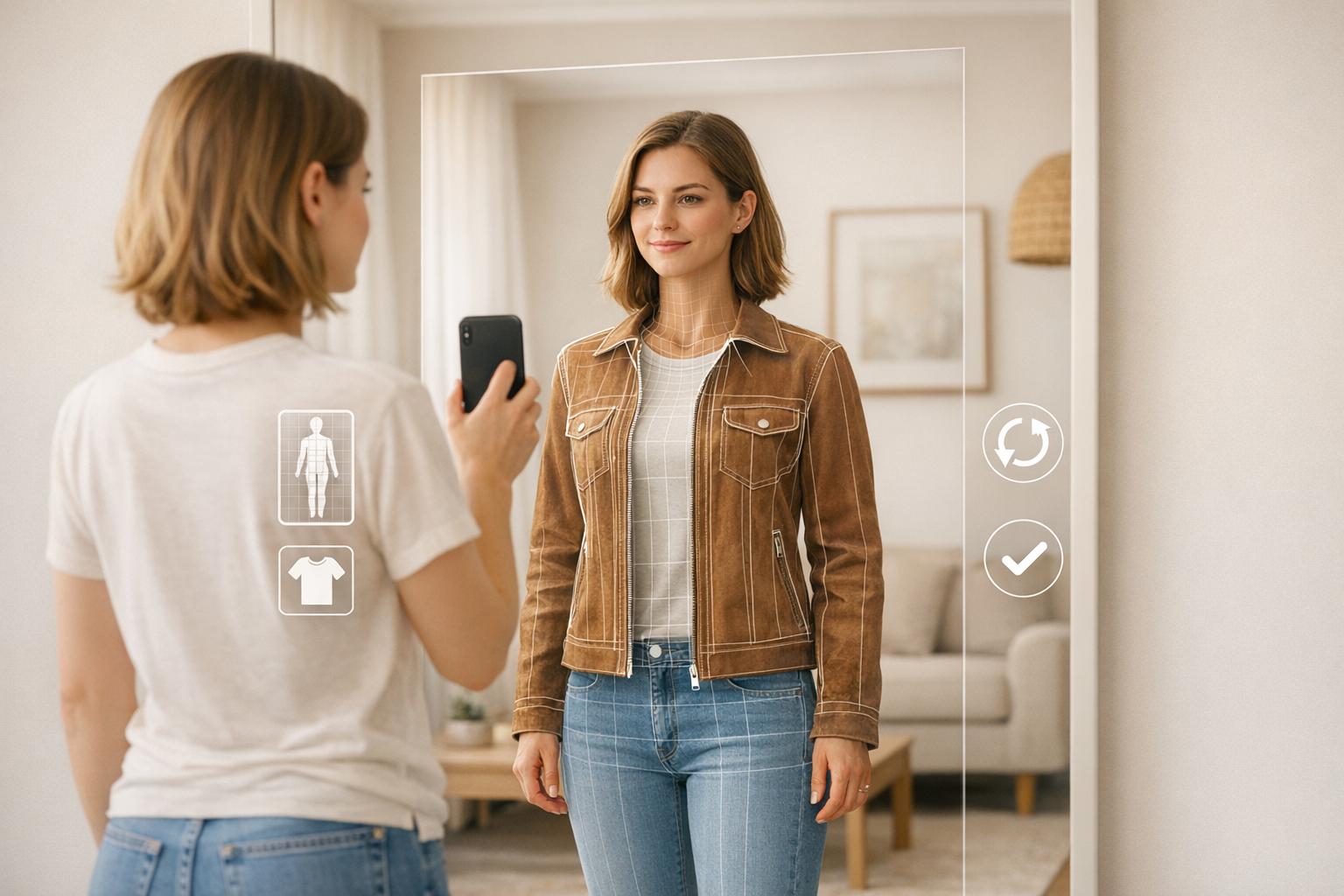
AI fashion try-on technology allows you to see how clothes, accessories, or makeup will look on your body without physically trying them on. It combines artificial intelligence (AI), augmented reality (AR), and 3D modeling to create lifelike simulations of fabric fit, draping, and movement. Here’s why it matters:
- How It Works: AI scans your body to create a digital model and overlays clothing images, simulating how they fit and move. Advanced systems use generative AI for highly realistic visuals.
- Why It’s Useful: It solves a major issue in online shopping – uncertainty about fit and size. This reduces return rates (by up to 40% in some cases) and increases customer confidence.
- Retailer Benefits: Businesses using virtual try-on see 20-30% higher conversion rates and fewer returns, saving millions in costs.
- Customer Engagement: Shoppers spend more time exploring products and feel represented with diverse digital models.
For example, tools like PixelPanda‘s AI Fashion Studio let users upload photos or select models to preview outfits in real time. With plans starting at $39/month, even small retailers can implement this technology to improve the shopping experience and reduce costs.

AI Fashion Try-On Technology: Key Statistics and Benefits for E-Commerce
😱 Try-On Clothes Using AI (INSANELY Realistic)
How AI Fashion Try-On Technology Works
AI fashion try-on combines three key technologies: Augmented Reality (AR), Artificial Intelligence with Computer Vision, and 3D Modeling. Together, these tools measure body dimensions, simulate fabric behavior, and create highly realistic visuals.
Augmented Reality (AR)
AR adds an interactive layer that overlays digital clothing onto your live camera feed or uploaded photos. When you use a virtual try-on feature on your smartphone, platforms like ARKit (for iOS) and ARCore (for Android) process the visuals in as little as 1 to 3 seconds. These systems track your body movements in real time, ensuring that virtual garments adjust seamlessly as you move.
To maintain a smooth experience, AR operates at a frame rate of over 30 FPS, avoiding lag. Advanced AI handles occlusion, which ensures proper layering when parts of your body overlap. For example, in June 2021, Amazon introduced an AR sneaker try-on feature in its app, allowing users to view shoes from brands like New Balance, Adidas, and Reebok from various angles.
Beyond simply overlaying clothing, AR integrates with AI to refine the fit and enhance details for a more realistic experience.
Artificial Intelligence and Computer Vision
Computer vision extracts 3D body measurements from 2D images or videos in real time. By analyzing over 50 data points – such as height, shoulder width, and waist circumference – AI creates a precise digital model of your body. This data is then matched with garment specifications to recommend the right size.
Modern systems use diffusion models to generate lifelike images, replacing older methods like geometric warping. Instead of pasting clothing images onto a photo, diffusion models create photorealistic visuals from scratch. In September 2024, Google expanded its generative AI try-on tool to include dresses. This tool, called VTO-UDiT (VTO-UNet Diffusion Transformer), acts like a virtual stencil, preserving your facial features and body identity while digitally changing your outfit.
Accuracy has improved significantly. Dr. Sarah Chen from MIT’s Computer Science and Artificial Intelligence Laboratory explains:
We’re now seeing less than 6% deviation from actual fit, compared to 30% just five years ago.
AI also powers physics engines to simulate how fabrics behave. For instance, silk drapes differently than denim, and the system accounts for stretch and movement based on the material. Today’s premium virtual try-on systems boast size prediction accuracy rates between 85% and 92%.
With precise measurements and AI-driven rendering, 3D modeling ensures that virtual garments adapt naturally to diverse body shapes.
3D Modeling and Scanning
3D modeling creates lifelike digital avatars and ensures virtual clothing fits naturally across different body types. By mapping key body landmarks, the system accurately positions garments. The 3D engine adapts dynamically, allowing clothes to move and drape realistically as you do.
Rendering happens in under 2 seconds, ensuring garments adjust instantly as you move. Devices equipped with LiDAR scanners, such as newer smartphones, can generate highly accurate 3D body models for even better results. However, accuracy varies depending on the fabric. For example, cotton and denim achieve 91% accuracy, while knit and stretch fabrics reach 76%.
To maintain accurate fit predictions, it’s recommended to update digital measurements every 3–4 months. Outdated data can lead to a 25% error in size recommendations.
How PixelPanda‘s AI Fashion Studio Works

PixelPanda’s AI Fashion Studio makes virtual try-ons easier and more realistic by using diffusion-based generative AI and customizable models. This platform allows both retailers and shoppers to see how clothing looks on a variety of body types, creating a more inclusive and personalized shopping experience.
How It Works
The process starts when users browse clothing items and select one with a "Try On" badge. After picking an item, they can either choose a model from PixelPanda’s diverse library or upload their own photo. This photo can be a full-body shot or even just a selfie. Once uploaded, the system creates a digital avatar that retains the user’s unique features while showcasing the selected outfit.
The platform generates photorealistic images in real time, capturing every detail of the fabric – how it drapes, folds, and stretches. PixelPanda’s diffusion models build each image pixel by pixel, ensuring the clothing looks as lifelike as possible.
Standout Features of PixelPanda’s AI Fashion Studio
PixelPanda offers features like product holding and outfit swapping, with subscription plans ranging from Starter at $39/month to Pro at $89/month. The model library includes sizes from XXS to 4XL (up to XXXL for dresses), making it easy to represent a wide range of body shapes. Models are carefully chosen to reflect various skin tones, ethnicities, and hair types, using the Monk Skin Tone Scale for guidance.
The technology behind the platform, called VTO-UNet Diffusion Transformer (VTO-UDiT), ensures that a person’s unique physical characteristics are preserved while digitally replacing clothing. This prevents the common distortion issues seen in older virtual try-on systems. For retailers, this means they can customize the experience for their audience, and for shoppers, it means they can create a personalized digital avatar in just seconds using a single selfie.
sbb-itb-76ad1b7
Benefits of AI Fashion Try-On for E-Commerce
Reducing Returns Through Better Fit Visualization
Fit-related issues are a major headache for online retailers, racking up $38 billion in refunds and $25 billion in processing costs every year. AI-powered fashion try-on technology is stepping in to tackle this problem by giving shoppers a realistic preview of how clothes will look and fit on their bodies.
Here’s how it works: the technology uses body mapping with over 50 data points, such as height, shoulder width, and waist circumference, to create highly accurate 3D models. Advanced physics engines then simulate how fabrics behave – whether they drape, stretch, or cling. The result? Virtual try-on systems can offer size recommendations with an impressive 92% accuracy rate, compared to just 60% for traditional online shopping.
The impact of this precision is clear. When one major retailer adopted virtual try-on, they slashed return rates by 40% and boosted conversions by 28%, saving an estimated $12 million in shipping and processing costs. Plus, there’s an environmental bonus: while standard returns generate about 4.5 kg of CO₂ each, virtual try-on reduces that to just 0.8 kg.
Improving Personalization and Inclusivity
One of the biggest frustrations for online shoppers – reported by 59% of them – is when a purchase doesn’t match their expectations. Generative AI helps bridge this gap by allowing customers to see clothing modeled on a diverse range of body types, sizes (XXS to 4XL), skin tones, and ethnicities. This inclusivity ensures shoppers feel represented and helps reduce the disconnect between what they see online and what they receive.
In June 2023, Google introduced a generative AI virtual try-on tool specifically for women’s tops. Using a diffusion-based model, the tool showcased garments on 80 different models spanning a variety of sizes. Maria Renz, VP and GM of Commerce at Google, highlighted the potential:
We’re very confident that this technology will lower returns. We’re pretty confident that that should help lower the cost for merchants in the end.
Beyond inclusivity, this technology enables shoppers to create highly personalized avatars based on their own measurements and preferences. The results speak for themselves: 94% of users engaging with advanced virtual try-on tools report greater satisfaction with their purchases.
Increasing Customer Engagement
AI-powered try-on features transform online shopping from a routine task into an interactive and enjoyable experience. For instance, virtual try-on images on Google Search receive 60% more high-quality views compared to standard product images. Retailers who have adopted this technology report conversion rate increases of 25% to 50%, and in many cases, customers spend twice as much time exploring their websites.
This interactive approach also inspires shoppers to experiment with bold colors and patterns, leading to a 20% jump in average order value. Jennifer Liu, Senior VP of Digital Innovation at Nike, shared:
Our virtual try-on adoption has reduced returns by 40% and increased customer confidence in online purchases. The ROI is clear: fewer returns mean lower environmental impact and higher profitability.
The benefits don’t stop there. Many consumers share their virtual try-on experiences on social media, creating organic buzz for brands. With 92% of Gen Z shoppers wanting AR tools integrated into e-commerce and 98% of users saying AR directly influenced their buying decisions, it’s clear this technology resonates strongly with younger audiences. These engagement stats make AI try-on tools a must-have for retailers looking to stay ahead of the curve.
Integrating PixelPanda’s AI Fashion Studio
If you’re looking to bring cutting-edge technology into your e-commerce business, PixelPanda’s AI Fashion Studio offers a straightforward way to do it. Here’s how you can make it work for you.
Choosing the Right Plan for Your Business
PixelPanda offers three subscription options to fit businesses of different sizes:
- Starter Plan: For $39/month (billed annually), you get 7,000 credits, which can be used for 350 videos and 7,000 images. This is perfect for smaller brands.
- Growth Plan: At $59/month, this plan includes 15,000 credits, covering 750 videos and 15,000 images.
- Pro Plan: For $89/month, you’ll receive 35,000 credits for 1,750 videos and 35,000 images.
All plans include features like outfit swapping, product holding, and multi-language video content. Plus, with virtual try-on implementation costs dropping by about 60% since 2020, even small retailers can now afford tools that were once reserved for big-name brands.
API Integration and Customization
To get started, review your current data flows, image quality, and cloud storage capacity. PixelPanda supports easy integration with popular platforms like Shopify, WooCommerce, and BigCommerce through "Plug & Play" plugins. For optimal performance, make sure your 3D models use low-poly designs and smaller textures, and focus on enabling WebAR for smooth mobile usability. Once integrated, test the system thoroughly and gather feedback to fine-tune its performance.
Using Diverse and Inclusive Model Options
PixelPanda’s AI Fashion Studio comes with a library of virtual models representing a variety of genders, ethnicities, body types, and regions. You can even upload your own models or brand ambassadors to ensure your fashion is showcased exactly how you want. With support for over 10,000 unique body shapes and sizes, the platform emphasizes inclusivity. This isn’t just a nice-to-have – it’s good for business. Brands that use realistic, diverse AI models have reported up to a 40% drop in returns related to fit and design.
As Rajashree Goswami puts it:
Virtual try-on succeeds when: It reflects real body diversity; It avoids beautification distortion; It embraces authenticity rather than perfection.
To maintain this level of representation, conduct regular audits to ensure your AI models are fair and accurately represent a broad range of body types and skin tones.
Conclusion
AI-powered fashion try-on tools have become a game changer for modern e-commerce, tackling one of the biggest hurdles of online shopping: sizing uncertainty. By blending augmented reality, computer vision, and generative AI, these tools bridge the gap between the physical and digital shopping experience. The results? Retailers are seeing higher conversion rates and fewer returns, making this technology a win-win for both businesses and customers.
As Rajashree Goswami aptly puts it:
Virtual try-on is no longer optional. It is the technological foundation of the next decade of fashion retail, one where accuracy strengthens trust, intelligence powers decisions, and personalization becomes the front door to customer experience.
For shoppers, this technology offers a more confident and accurate buying experience, reducing the risk of sizing mistakes. For retailers, it translates to lower costs and better inventory management. With 98% of shoppers saying augmented reality directly influenced their purchasing decisions, the value of this innovation is undeniable.
PixelPanda’s AI Fashion Studio makes this technology accessible for businesses of all sizes, starting at just $39/month. Whether you’re running a small boutique or scaling a larger brand, integrating virtual try-on tools is no longer just a nice-to-have – it’s what customers expect. Businesses that adopt these tools today will be the ones setting the standard for the future of fashion retail.
FAQs
How does AI-powered fashion try-on enhance online shopping?
AI-driven fashion try-on technology lets shoppers virtually preview how clothes and accessories will look on them. By leveraging tools like augmented reality and machine learning, it creates personalized virtual avatars or overlays items onto a user’s photo or video. This enables customers to visualize fit, style, and color, helping them feel more confident about their choices before making a purchase.
This technology not only enhances the online shopping experience but also helps retailers tackle major challenges. It can lead to higher customer satisfaction, improved conversion rates, and fewer returns – making online shopping more interactive and reliable for both shoppers and businesses.
What technologies make AI fashion try-on so accurate?
AI-powered fashion try-ons deliver impressive precision by blending several cutting-edge technologies. Computer vision plays a key role in analyzing body shapes and poses, while 3D garment modeling replicates fabric textures and movements, making clothing appear lifelike. Augmented reality (AR) adds another layer by enabling users to visualize outfits directly on their bodies in real time. Additionally, machine learning – including tools like generative AI – predicts how garments will fit and appear across various body types. Together, these technologies create highly realistic and interactive shopping experiences, helping shoppers feel more confident about their online purchases.
How can small businesses benefit from AI fashion try-on technology?
AI-powered fashion try-on tools are transforming how small businesses approach online shopping. These tools let customers virtually try on clothes, giving them a better sense of how items will fit and look on their own bodies. The result? Shoppers feel more confident about their purchases, leading to increased sales, fewer abandoned carts, and a noticeable drop in costly returns.
But the benefits don’t stop there. These tools also provide businesses with valuable data about customer preferences – like which sizes, colors, and styles are most in demand. Armed with this information, small businesses can fine-tune their inventory, avoid overstock issues, and craft marketing campaigns that hit the mark – all without needing a hefty budget. Plus, the engaging and personalized shopping experience keeps customers coming back and encourages them to share their positive experiences with others.
Another huge advantage is cost savings. AI try-on technology eliminates the need for physical fitting rooms and pricey photo shoots. It’s a practical, scalable solution that boosts shopper confidence while keeping operational costs low. For small businesses navigating the competitive e-commerce world, this tech offers a smart way to stand out and grow.