Think of AI marketing not as a robot overlord coming for your job, but as the ultimate sidekick giving your campaigns a serious upgrade. It’s all about using smart tech to handle the boring, repetitive stuff, get inside your customers' heads, and make decisions based on cold, hard data. This frees you up to do what you do best: strategy and creativity.
Welcome to Your AI-Marketing Adventure
Ever feel like you're trying to build a masterpiece with a giant, unsorted pile of LEGOs? That's what traditional marketing can feel like sometimes—a whole lot of manual sorting and guesswork. AI-marketing is like having a master builder who sifts through that pile, finds the perfect pieces, and assembles your vision in record time. It’s about working smarter, not just harder.
The big idea here is pretty straightforward: use intelligent systems to truly understand your audience, pump out amazing content at scale, and fine-tune your campaigns with surgical precision. Instead of throwing things at the wall to see what sticks, AI digs into real-time data to show you exactly what will stick. It's not just some tech buzzword anymore; it's a core part of how modern marketing gets done.
A New Era of Marketing Growth
The numbers don't lie. The AI marketing world is expected to blow past $107.5 billion by 2028, and it's easy to see why. A recent poll found that a whopping 88% of marketers are already using AI tools in their daily grind. Even more telling? 93% of them say these tools help them create content way, way faster. If you want to get a solid handle on the basics, this guide on AI for social media marketing made simple is a great place to start.
AI doesn’t just speed up old processes; it creates entirely new possibilities. It’s the difference between using a map and having a GPS that reroutes you around traffic in real time.
To really see the difference, let's put the old way and the new way side-by-side.
AI-Marketing vs Traditional Marketing A Quick Comparison
This table breaks down the fundamental differences between traditional marketing approaches and modern AI-powered strategies, highlighting key areas like personalization, speed, and decision-making.
| Marketing Function | Traditional Approach (The Hard Way) | AI-Powered Approach (The Smart Way) |
|---|---|---|
| Personalization | Broad segmentation based on demographics. | Hyper-personalization based on individual behavior. |
| Campaign Speed | Slow manual setup and deployment. | Rapid, automated campaign creation and launch. |
| Content Creation | Time-consuming manual production. | On-demand, AI-assisted content generation. |
| Decision-Making | Based on historical data and gut feelings. | Driven by real-time predictive analytics. |
| Optimization | Manual A/B testing with limited variations. | Continuous, automated multi-variate testing. |
See the pattern? One path is manual and slow, while the other is automated, data-driven, and lightning-fast.
From Manual Labor to Strategic Superpowers
Consider this guide your no-fluff, jargon-free tour of this exciting new world. We're going to dive into how AI is completely changing the game, making campaigns more powerful and personal than you ever thought possible. Forget the sci-fi stuff—we're talking real tools, real strategies, and real results.
Here’s a quick look at what that actually means for your day-to-day:
- Deeper Customer Insights: Figure out what your audience really wants, sometimes even before they do.
- Massive Efficiency Gains: Automate the soul-crushing tasks. Think of creating hundreds of visual assets for A/B tests. A tool like PixelPanda can take complex image editing off your plate, literally saving your team hundreds of hours.
- Enhanced Creativity: Use AI as your creative co-pilot to brainstorm fresh ad copy, blog ideas, and entire campaign angles.
- Better Decision-Making: Let predictive analytics guide your budget, putting your money where it will make the biggest splash.
In the end, AI marketing is about graduating from being a campaign operator to becoming a strategic architect. You get to build smarter, more meaningful experiences that truly connect with people.
The Core Superpowers of AI Marketing
To really get what makes AI marketing such a game-changer, you don’t need a computer science degree. Just think of it as a marketing Swiss Army knife with four incredible new tools. Let's pop the hood and see what these superpowers actually do.
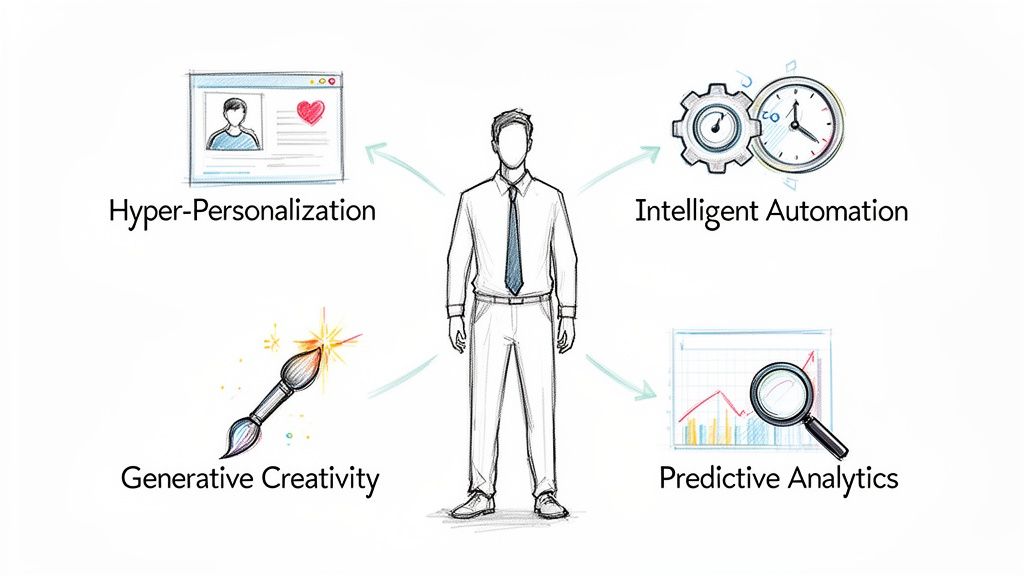
Hyper-Personalization at Scale
Ever feel like Netflix just gets you when it suggests that obscure documentary? Or how Spotify curates a playlist that perfectly matches your mood? That’s AI-powered hyper-personalization, and it's all about treating every single customer like they're your only one, even if you have millions.
Old-school marketing lumped people into broad buckets like "males, 25-35, interested in sports." AI blows that out of the water. It dives deep, analyzing individual browsing habits, past purchases, and even how someone is clicking around your site in real-time to craft a totally unique experience.
It’s the difference between a generic flyer and a personal recommendation from a friend. One person sees a specific product, another gets a blog post tailored to their interests—all happening at the exact same time. It's a one-to-one conversation, scaled to infinity.
Intelligent Automation
Next up is the superpower that hands you back your most precious resource: time. Think of intelligent automation as the world's best intern—one that works 24/7, never makes a mistake, and handles thousands of tedious tasks every minute. This is the engine that keeps AI marketing humming.
It’s the behind-the-scenes wizardry that makes modern campaigns feel effortless.
- Smart Scheduling: Forget guessing. AI analyzes engagement data to pinpoint the absolute best time to send an email or drop a social media post for maximum impact.
- Automated Ad Bidding: Instead of manually fiddling with bids on Google or Facebook, AI systems manage them on the fly, fighting for the lowest possible cost-per-acquisition.
- Lead Scoring: AI automatically sifts through your leads and ranks them based on how likely they are to buy. This lets your sales team focus their energy only on the hottest prospects.
Generative Creativity Unleashed
Okay, this is where things get really fun. Generative AI is like having a creative genius on your team who can brainstorm and produce amazing content at mind-blowing speed. This is the superpower that smashes through creative blocks and lets you test more ideas than you ever thought possible.
Imagine you need a new ad campaign. You can feed a generative AI a simple prompt like, "Create a summer-themed ad for our new sneakers." In seconds, you get dozens of options for ad copy, catchy headlines, and even the stunning visuals to go with them.
This completely flips the script on content creation. What used to be a slow, manual grind becomes a rapid-fire ideas factory. You can spin up hundreds of ad variations for A/B testing and find the winner in hours, not weeks.
Predictive Analytics and Optimization
Finally, we have the crystal ball. Predictive analytics is the AI superpower that lets you peek into the future of your marketing campaigns. By crunching massive amounts of data on past performance and current market trends, AI can forecast outcomes with startling accuracy.
This isn’t just about looking in the rearview mirror to see what happened; it's about predicting what will happen next. For example, an AI model can flag which customers are about to churn, giving you a chance to step in with a retention offer before they walk away.
Better yet, this power fuels continuous optimization. AI doesn’t just launch a campaign and report back later. It actively tweaks and refines it in real time. If one ad is flopping, the system can automatically shift the budget to a top performer, making sure you’re always getting the most bang for your buck.
Say Goodbye to Photoshop Drudgery: AI is Your New Creative Workhorse
If there's one place where AI marketing feels like actual magic, it's in the world of visual content. For what feels like an eternity, creative teams have been stuck in a tedious loop with Photoshop, sinking hours into mind-numbing tasks like cutting out backgrounds or resizing a mountain of banners.
AI is completely flipping that script. It’s turning hours of manual labor into seconds of automated brilliance.
Think about it: instead of a designer spending an entire day meticulously isolating five product photos, an AI can churn through five thousand in an hour. This isn't just about moving faster; it's about opening up a world of creative possibilities that were once too expensive or time-consuming to even dream of.
From Pixel-Pusher to Creative Strategist
The real change here is how it shifts the team's focus. AI takes over the repetitive, technical grunt work, freeing up your talented humans to focus on what they do best: brainstorming big-picture ideas and crafting compelling strategies.
This is where API-first tools like PixelPanda really come into their own. They plug directly into a company’s existing systems, essentially creating a seamless assembly line for stunning visuals.
This workflow shows exactly how a single API call can kick off a sophisticated visual production process.
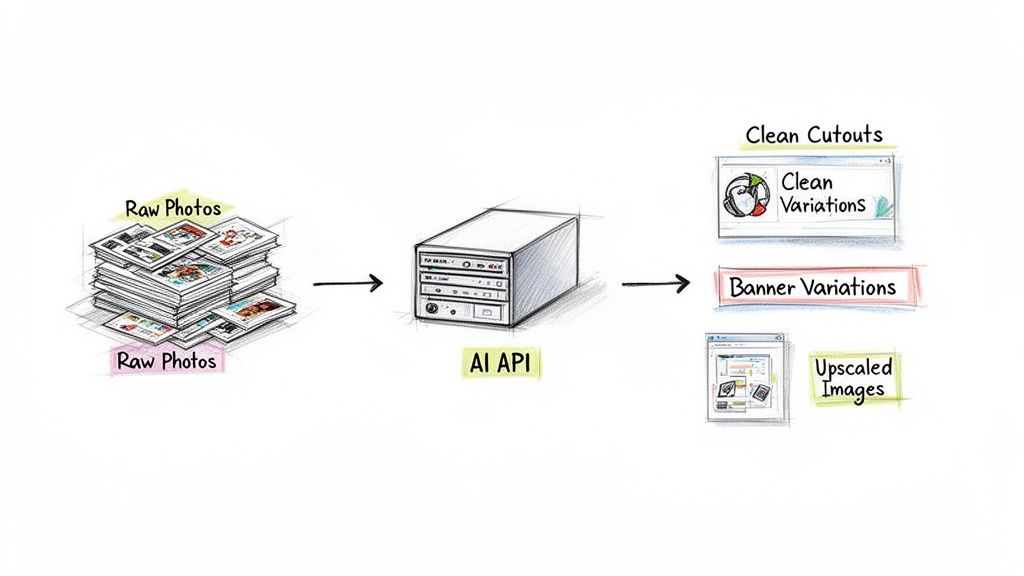
As you can see, raw photos are programmatically transformed into polished, campaign-ready assets—all without anyone lifting a finger.
This kind of automation creates an incredibly powerful feedback loop for any AI-marketing strategy. You can instantly generate hundreds of ad variations to pinpoint the winner, refresh website imagery on the fly, or even turn user-generated content into clean, on-brand assets in a heartbeat.
Unleashing Visuals at a Scale You've Never Seen
Let's break down what this looks like in the real world. Here are a few ways AI is completely changing the game for visual content:
- Flawless Product Cutouts: An e-commerce store can automatically strip the background from thousands of new product photos, guaranteeing a crisp, consistent look across its entire catalog.
- Endless A/B Testing: A marketing team can spin up hundreds of unique social media banners from a single product shot and a line of copy. This allows for lightning-fast testing to find the creative that actually converts.
- Print-Ready Perfection: That blurry, low-res photo a customer sent over? AI can automatically upscale it into a sharp, high-quality asset perfect for a print campaign. Don't believe it? You can see the magic for yourself with this https://pixelpanda.ai/demos/image-upscaling-demo.
This jump from manual editing to automated production isn't just a small bump in efficiency—it's a complete reimagining of the creative workflow. It lets teams operate at a scale and speed that was simply out of reach before.
And the industry is catching on fast. According to a recent report on digital advertising trends, 46% of marketers are now using AI specifically to scale their creative output. An incredible 95% are experimenting with AI for creative production, largely because they're tired of waste—with some estimating that up to 30% of their marketing budgets are misspent.
The Future is Both Programmatic and Creative
This new reality isn't limited to static images. AI is also making massive leaps in motion graphics and video. To really get a handle on how AI is expanding what's possible, check out some of the top AI video creation tools for marketers. You'll find new ways to generate everything from short-form social clips to full-blown explainer videos.
Ultimately, this is all about giving marketers superpowers. With an API like PixelPanda, a developer can write a few lines of code to programmatically add watermarks, conjure up new lifestyle scenes from a simple text prompt, or enhance facial features across an entire library of photos.
The creative team sets the vision, and the AI executes it flawlessly, turning ambitious ideas into real-world assets at the speed of thought.
Alright, let's move past the theory. It's one thing to talk about what AI marketing can do, but it's way more interesting to see what it's actually doing for real businesses. These aren't just hypothetical scenarios; these are stories from the trenches where smart AI tools are solving frustrating problems and making a real impact.
You'll see how a single, well-placed AI integration can take a painful bottleneck and turn it into a high-octane growth engine.
The E-commerce Explosion
Picture this: an online fashion brand, poised for a major launch. They had a massive catalog of 10,000 unique products ready to sell, but there was one huge problem. Their small design team was stuck in Photoshop, manually clipping the background out of every single product photo. It was a soul-crushing, tedious task.
This manual process created a massive delay, stretching their time-to-market from a couple of days to several weeks. New collections were just sitting in a warehouse, gathering dust, while competitors were dropping fresh styles almost daily. It was a direct hit to their revenue.
So, they decided to try something different. They plugged an AI-powered image editing API directly into their product upload system. Suddenly, every time a new photo was uploaded, the AI instantly churned out a perfect, clean product shot with a transparent background. The work that once took weeks of grinding was now done in hours, with zero human oversight.
The result was a total game-changer. The brand sliced its time-to-market from weeks down to just a few days. With professional, consistent product shots hitting their site faster than ever, they watched their conversion rates jump by 15%. Turns out, speed and quality really do sell.
The Scalable Social Campaign
Now let's look at a digital marketing agency that was hitting a wall. They were running social media ad campaigns for multiple clients, but their designers were completely burnt out. To properly A/B test ad creative, they needed tons of visual variations, and creating them all by hand was slow, expensive, and just not scalable.
They couldn't possibly test hundreds of creative concepts without hiring a whole new department of designers. They needed a better way.
Their solution was an AI-marketing tool designed for creative generation. They could upload a single product image and a few lines of ad copy, and the AI would spit out hundreds of ad variations—different backgrounds, layouts, headlines, you name it. It built them a massive library of testable visuals in minutes.
With this new arsenal, the agency could launch campaigns with an enormous volume of creatives. They let the ad platform's own algorithm do the heavy lifting, quickly sorting through the options to find the winning combinations based on live performance data.
This completely flipped their workflow on its head. They could identify the top-performing ads in a matter of hours, not weeks. Better yet, by letting data guide their creative choices, they cut their clients' average cost-per-acquisition by a whopping 40%. Now that's a win.
Your AI Marketing Game Plan
Feeling that itch to dive in? Good. But adopting AI in your marketing doesn't mean you have to tear down your whole operation and start from scratch. Think of it more like adding a turbocharger to an engine you already know and love. It's about smart, calculated upgrades.
This roadmap will walk you through it, step-by-step, so you can start making moves right away without the overwhelm.
First, Find the Bottleneck
Before you do anything else, you have to find the pain. Every single marketing team has that one task—the one that’s a black hole for time, energy, and budget.
Is it the soul-crushing crawl of producing creative assets? Or maybe it's the endless A/B testing that feels more like guesswork than science? Pinpoint the single biggest point of friction in your workflow. Don't try to boil the ocean. The goal here is to find one high-impact area where AI can give you an immediate, satisfying win.
This is all about turning those nagging problems into clear, measurable successes.
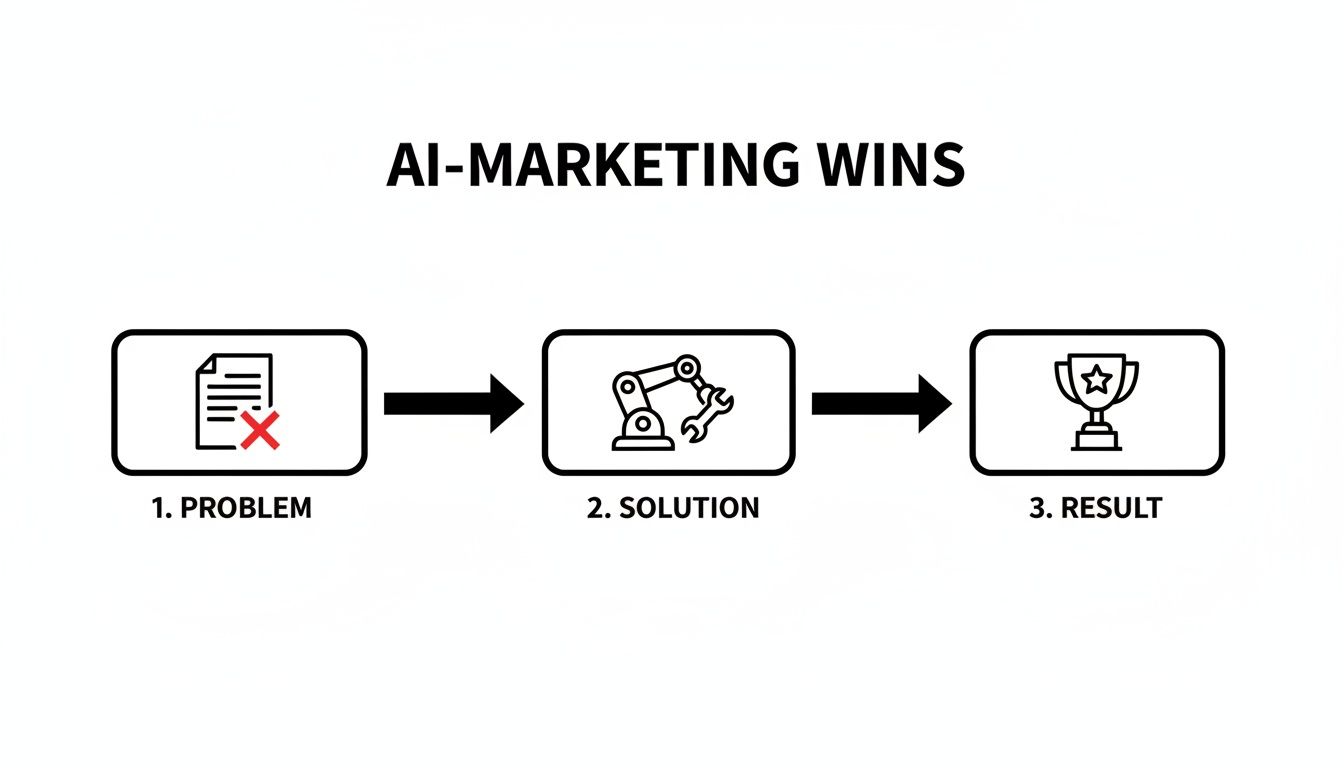
The formula is simple: identify a problem, point an AI solution at it, and watch the results roll in.
Start Small, Win Big: The Pilot Project
Once you've zeroed in on your bottleneck, it's time to run a small, focused test. This isn't about signing a massive, scary contract. It’s about getting a taste of real results, fast.
If slow creative production is your headache, a perfect pilot project is using an AI tool to automate one tiny piece of that visual workflow.
For instance, grab a batch of 50 product photos and run them through an API-first platform like PixelPanda to automatically remove the backgrounds. Now, compare the time and money spent versus doing it the old-fashioned way. Just like that, you have a rock-solid, data-backed case for expanding.
The Goal of Your Pilot: Prove the value of AI on a small, manageable scale. You're hunting for undeniable evidence that this tech saves time, cuts costs, or boosts quality before you go all-in.
Pick the Right Tools for the Job
Let's be real: not all AI tools are built the same. As you start looking at platforms, ignore the flashy marketing and focus on what actually matters for your workflow: scalability and integration.
The way people search is changing fast. It's becoming a conversation with an AI, and for your brand to show up, you need a deep library of high-quality, adaptable creative assets. As Google points out, this new world of "Generative Engine Optimization" is coming, and having the right tools is the only way to prepare. You can read more about upcoming digital marketing trends on business.google.com.
When you're choosing your tool, make sure it checks these boxes:
- API Power: A flexible, well-documented API isn't a "nice-to-have," it's a must. This is what allows the tool to plug directly into the systems you already use. See for yourself what a developer-friendly API offers.
- No PhD Required: Your team should be able to jump in and start using it without needing a month of training.
- Ready to Scale: Can the tool handle your volume when you go from 100 images a month to 100,000? It has to grow with you.
Measure Everything, Celebrate Every Win
Finally, you have to track your progress. In the world of AI marketing, data is your absolute best friend for proving ROI.
Get specific with your metrics:
- Time Saved: How many team hours did you get back?
- Cost Per Asset: By how much did your production costs drop?
- Campaign Lift: Did the AI-enhanced assets actually boost engagement or conversion rates?
Track these numbers from your pilot project onward and shout the wins from the rooftops. This is how you build momentum and get the whole team fired up for what's next on your AI journey.
Got Questions About AI Marketing? We've Got Answers.
Jumping into the world of AI marketing can feel like you're plugging into The Matrix for the first time. It's exhilarating, maybe a little disorienting, and you’ve probably got a million questions. Is a robot coming for my job? Is this just for giant companies with servers in the basement?
Don't sweat it. These are the exact questions every savvy marketer is asking right now. Let's pull back the curtain and tackle the big ones so you can go from curious to confident.
So, Is AI Marketing Going to Replace My Job?
Let's get the big one out of the way first: absolutely not. Think of AI as the ultimate sidekick, not your replacement. Your job isn't going anywhere—it's just getting a massive upgrade.
AI is a beast at the heavy lifting—chewing through data, knocking out repetitive tasks, and spitting out a thousand image variations while you sleep. This doesn't make you redundant; it makes you indispensable. You’re the strategist, the creative director, the human with the intuition to guide the AI, interpret its output, and decide what actually resonates with people.
In fact, a recent study found that 75% of marketers see their roles shifting more toward strategy as AI takes over the grunt work. Your expertise just became more valuable, not less.
Is This AI Stuff Only for Big Companies with Deep Pockets?
That’s one of the biggest myths floating around, and it's completely outdated. A few years ago? Sure, maybe. But today, the game has changed entirely.
Powerful AI marketing tools aren't locked away in some corporate vault anymore. Many of the best platforms run on flexible, pay-as-you-go models, making them shockingly accessible for businesses of all shapes and sizes.
You don't need a platoon of data scientists or a Silicon Valley budget to get in on the action. You can see a real return just by automating a few key tasks, like cleaning up product photos or generating social media posts.
Plenty of tools even offer generous free trials, letting you prove their worth before spending a single dollar. The barrier to entry has crumbled, leveling the playing field for startups and small businesses to punch way above their weight.
How Do I Even Get Started with AI for Visuals?
Dipping your toes in is way easier than you think. The trick is to resist the urge to boil the ocean. Just follow this simple, three-step playbook:
- Find Your Biggest Headache: First, figure out the most soul-crushing visual task your team deals with. Is it manually removing backgrounds from a constant stream of product shots? Is it creating endless ad variations? Find the one job that makes everyone groan.
- Run a Tiny Pilot Project: Don't go all-in right away. Start with a small, contained test. For instance, grab 20 of your trickiest images and run them through a free trial with a platform like PixelPanda.
- Measure, Then Expand: Look at the results. Compare the time, cost, and final quality to your old, manual way of doing things. Once you have that undeniable win, you’ve got all the ammo you need to start rolling it out on a bigger scale.
The key is to start small, prove the value, and build momentum. One successful test run is all it takes to get the ball rolling.
What Metrics Should I Actually Be Tracking?
The metrics you watch will depend on your specific goals, but the beauty of AI is how it helps you move the numbers that really matter. Forget vanity metrics—we're talking about tangible business impact.
Here are a few key areas to keep an eye on:
For Creative Production:
- Time to Market: How much faster can you launch a new campaign or get a product line online? This is a direct measure of your team's agility.
- Content Velocity: How many more top-notch assets can your team crank out in the same amount of time?
- Cost Per Asset: The bottom-line number. How much are you saving on the creation of every single image or video?
For Campaign Performance:
- Conversion Rate Lift: Are the AI-powered visuals actually getting more people to click "buy"?
- Return on Ad Spend (ROAS): By testing more creative options faster, you find the winners and make your ad budget work harder for you.
- Customer Lifetime Value (CLV): Better, more personalized experiences create happier customers who stick around and spend more.
Just be sure to benchmark your current performance before you start. That way, you can confidently show everyone the incredible ROI you're delivering.
Ready to stop wasting time on tedious visual tasks and start focusing on what really matters? With the PixelPanda API, you can automate everything from background removal to image upscaling. See what you can build and start your free trial today.