Ever feel like you're stuck on a marketing treadmill, running faster just to stay in the same place? That's where AI marketing comes in. It’s not about working harder; it’s about working smarter.
Think of your marketing team as a fantastic rock band—talented, creative, and full of energy. Now, imagine giving them an AI-powered sound engineer who can instantly tune every instrument, read the crowd's vibe in real-time, and make your garage band sound like they’re playing a sold-out stadium. That’s the kind of upgrade we're talking about.
So, What Is AI Marketing, Really?
Let's get one thing straight: AI marketing isn't about firing your team and hiring a fleet of robots. It's about giving your people superpowers.
At its heart, it’s using smart technology to make automated decisions, create uniquely personal experiences for customers, and chew through data at a speed no human ever could. It’s the difference between hunting for a needle in a haystack and having a super-magnet that pulls it right out for you—along with five other things you didn't even know you needed.
You already see this magic every day. When Netflix queues up a show you instantly binge, or Amazon suggests a product that feels like it was made just for you, you're looking at AI in action. Those same powerful ideas are now completely reshaping how brands build relationships with people.
From Manual Grind to Automated Wins
For decades, marketing has been a messy mix of creativity, gut feelings, and a whole lot of manual labor. AI tips the scales, injecting hardcore data precision right into the creative process.
Instead of burning hours manually segmenting email lists or tweaking ad bids until your eyes cross, marketers can now hand those jobs over to intelligent systems. These systems don't just follow orders; they learn and get better on their own, 24/7. This frees up your team's brainpower for the fun stuff: big-picture strategy, brilliant creative ideas, and actually talking to your customers.
The heavy lifting AI does usually falls into a few buckets:
- Data Analysis: AI is a master at sifting through mountains of data to spot weird patterns in customer behavior, catch emerging trends, and even predict what might happen next.
- Hyper-Personalization: This is how you deliver true one-to-one experiences. AI helps tailor everything—content, offers, emails—to what each individual person actually wants.
- Intelligent Automation: From scheduling a month's worth of social media posts to running incredibly complex ad campaigns, AI handles the repetitive stuff with flawless efficiency.
- Content Creation: Need a hundred different versions of ad copy? Or a dozen email subject lines to test? AI tools can help generate text and even visual ideas, dramatically speeding things up.
AI marketing isn't some sci-fi dream for the future. It’s the new normal for any business serious about growing without burning out. By automating the predictable, you empower your team to create the exceptional.
Why This Is a Big Deal Right Now
Today’s customers don't just want a personalized experience—they expect it. A recent McKinsey study revealed that 71% of consumers expect personalization, and the companies that deliver it see 40% more revenue.
Trying to meet that expectation by hand is a recipe for disaster. It’s simply not possible at scale. To get a real sense of what's possible today, check out a modern playbook for AI for advertisers. It breaks down exactly how top teams are already using AI to automate their creative workflows and deliver personalization that actually works.
It's time to step off the treadmill and start building an intelligent system that doesn't just do the work, but multiplies your team's creativity and drives real, measurable growth.
How AI Marketing Actually Works
So, what’s really going on behind the curtain of AI marketing? Let’s skip the dense, technical jargon and get straight to it.
At its heart, AI in marketing is all about using mountains of data to make smarter, faster, and more accurate decisions. Forget thinking of it as a simple calculator. It’s more like a chess grandmaster who’s not just looking at the next move, but is ten steps ahead, anticipating every possible outcome and adjusting their strategy on the fly.
This isn't just a single piece of tech, but a whole crew of specialized systems working together. Each one has a specific job, and understanding how they team up is the key to seeing how AI turns a generic, one-size-fits-all campaign into a genuinely personal conversation with your customers.
And this isn't some far-off future concept; it's happening right now. A whopping 64% of UK marketers are planning to up their AI spending by 2026. On top of that, 43% of marketers are already using AI to get rid of tedious, repetitive tasks, freeing them up to do the creative, big-picture thinking that actually moves the needle. You can dive deeper into these trends with these AI marketing statistics for 2026.
Let's meet the key players on the team.
The Brains of the Operation: Machine Learning
Think of Machine Learning (ML) as the system’s constantly learning brain. It’s the engine that drives most AI marketing tools, and its superpower is its ability to learn from new data without someone needing to manually program every single rule.
Every time a customer clicks a link, abandons a cart, or binge-watches a product video, the ML model is paying attention. It spots the subtle patterns in human behavior that no person could ever catch across millions of interactions. This is why AI-powered personalization feels so spot-on—it literally gets smarter with every bit of data it sees.
For example, an e-commerce store's recommendation engine uses ML to figure out that people who buy hiking boots are also very likely to buy wool socks and a waterproof jacket in the next two weeks. It then automatically suggests those products at just the right time, making a sale feel more like a helpful suggestion than a pushy ad.
This whole process creates a powerful feedback loop, driving growth by constantly improving the customer experience.
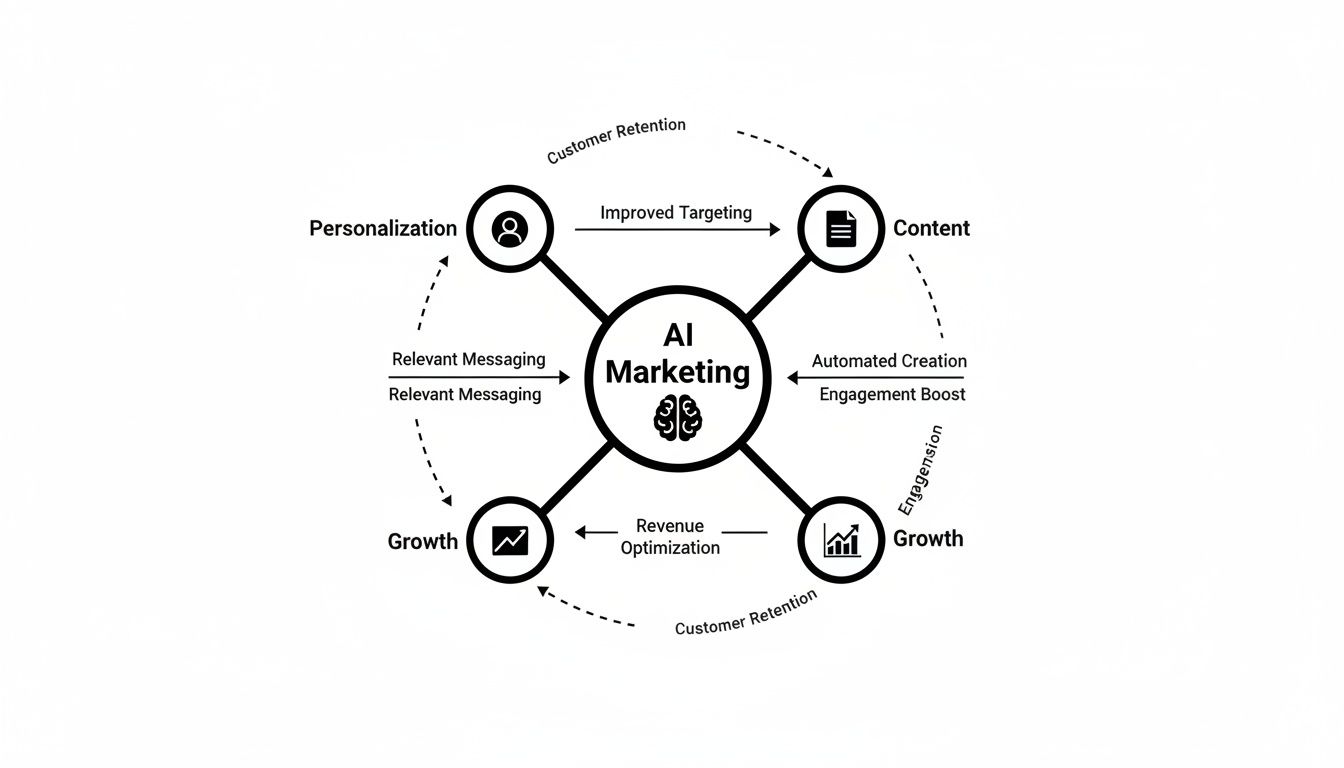
As you can see, AI isn’t just a one-off trick; it’s the central engine that connects and supercharges every part of your marketing flywheel.
To give you a clearer picture, here’s a quick breakdown of the core technologies and how they're actually used in the wild.
Core AI Technologies in Marketing
| AI Technology | What It Does | Real-World Marketing Example |
|---|---|---|
| Machine Learning (ML) | Learns from data to find patterns and make predictions without being explicitly programmed. | A Netflix algorithm analyzing your viewing history to recommend shows you'll probably love. |
| Natural Language Processing (NLP) | Enables computers to understand, interpret, and generate human language. | A customer service chatbot on a website that can answer your questions instantly, day or night. |
| Predictive Analytics | Uses historical data and ML to forecast future events, behaviors, and trends. | An e-commerce platform predicting which customers are at risk of churning and sending them a targeted "we miss you" offer. |
| Computer Vision | Allows machines to "see" and interpret visual information from images and videos. | PixelPanda automatically removing the background from thousands of product photos to create a consistent, professional look for a storefront. |
| Generative AI | Creates new, original content—like text, images, or code—based on the data it was trained on. | Using a tool like Jasper to brainstorm dozens of creative ad headlines in seconds. |
These technologies often work in tandem, creating a marketing machine that's far more powerful than the sum of its parts.
The Ears and Mouth: Natural Language Processing
If Machine Learning is the brain, then Natural Language Processing (NLP) is the system’s ears and mouth. It's the magic that lets machines understand, interpret, and even generate human language, both written and spoken.
This is the tech behind everything from the chatbots we talk to online to the tools that can tell you how people really feel about your brand on social media.
- Sentiment Analysis: NLP can instantly scan thousands of tweets, product reviews, and forum comments to give you a real-time pulse check on your brand’s reputation. Is the vibe positive, negative, or just meh?
- Chatbots and Virtual Assistants: Good chatbots use NLP to understand what customers are asking—typos, slang, and all—and provide genuinely helpful answers 24/7.
- Content Generation: AI writing assistants use NLP to whip up drafts for blog posts, catchy email subject lines, and social media captions, cutting down content creation time dramatically.
The Crystal Ball: Predictive Analytics
Last but not least, we have Predictive Analytics, which acts as the system's crystal ball. By sifting through historical data, it uses statistical algorithms and ML to forecast what’s likely to happen next.
Predictive analytics is what shifts your marketing from being reactive to proactive. Instead of just analyzing what happened yesterday, you get a data-driven glimpse into what’s probably coming tomorrow.
This lets you get ahead of the game. For instance, it can flag customers who are showing signs of drifting away, so you can step in with a retention campaign before they leave for good. It can also predict which products are about to trend, helping you stock up on inventory and aim your ad budget where it will have the biggest impact.
Together, these technologies give modern marketers a toolkit that would have seemed like science fiction just a few years ago.
The Real-World Payoff: Why AI Marketing Is a Game-Changer
Alright, let's cut through the buzzwords and get down to what really matters: the results. Bringing AI into your marketing isn't just about grabbing the latest shiny object; it’s about a fundamental upgrade to how you find customers, make sales, and grow your business. The perks aren't just theoretical—they're real, they're measurable, and they can give you an almost unfair advantage.
We're not talking about small, incremental improvements here. A deep dive by McKinsey found that companies who truly weave AI into their marketing and sales see a 5-15% jump in revenue and a 10-30% boost in efficiency. That's the kind of shift that turns marketing from a budget line item into a powerhouse growth engine.
So, how does this actually happen? It all comes down to a few core benefits that completely rewrite the rules of the game.
Crafting One-to-One Experiences at Scale
For decades, the ultimate goal in marketing has been true personalization—making every single customer feel like they're the only customer. But for most of that time, it was a fantasy. You could either go deep with a few VIPs or blast a generic message to the masses. There was no in-between. AI completely demolishes that trade-off.
It unlocks hyper-personalization at scale, letting you create unique, one-on-one experiences for thousands or even millions of people all at once. By crunching individual browsing habits, purchase histories, and real-time actions, AI can deliver the perfect ad, product recommendation, or email at the precise moment it will land best.
It’s the difference between a shopkeeper who just says, "Can I help you?" to everyone, and one who remembers your name, asks how you liked your last purchase, and already has a few new things in mind you're going to love. AI becomes that hyper-aware shopkeeper for your entire customer base.
Achieving Radical Operational Efficiency
Just think of all the tedious, soul-crushing tasks that drain your marketing team's day. Manually sorting email lists, endlessly A/B testing ad creatives, pulling the same reports every Monday morning, and trying to optimize campaign bids across a dozen platforms. These jobs are necessary, but they kill creativity and bog everyone down.
AI marketing puts these repetitive, data-heavy chores on autopilot. It works around the clock, never needs a coffee break, and fine-tunes campaigns with a level of precision no human team could ever hope to match. This frees up your brilliant human marketers to do what they do best: dream up big ideas, build real relationships, and map out the next big strategic move.
Let’s look at a classic e-commerce headache: the abandoned cart. A fashion retailer was bleeding revenue from shoppers who’d load up a cart and then vanish. Instead of just sending out a generic "Did you forget something?" email, they plugged in an AI-powered system.
- The AI figured out why the cart was ditched. Was it a big order where the price caused hesitation? It automatically sent a small, time-sensitive discount.
- Was the shopper browsing other similar items? The follow-up email showcased those exact alternatives.
- Did they linger on one specific product page? It pinged them when that item's stock was running low.
The bottom line? They cut cart abandonment by over 20% and got a direct lift in monthly sales, all without a single person on the team having to manually track or send anything.
Making Decisions with Data-Driven Certainty
Let's be honest, a lot of marketing has felt like educated guesswork. You launch a campaign based on experience and a bit of gut instinct, then cross your fingers and hope the numbers look good. AI replaces that nervous uncertainty with cold, hard confidence.
Using predictive analytics, AI can forecast how a campaign will likely perform, spot your next group of high-value customers before they even buy, and flag users who are at risk of churning. It turns marketing from an art into a much more predictable science. You’re no longer just looking in the rearview mirror; you're using intelligent forecasting to shape what's coming. This means you can put your budget where it will have the biggest impact, prove your ROI with solid data, and build a marketing machine that delivers consistent, reliable growth.
Putting AI to Work in Your Business
Alright, let's get down to brass tacks. It's one thing to talk about AI marketing in theory, but it’s a whole different ball game to figure out where it actually fits into your daily grind. The best part? You don’t need a Silicon Valley budget or a room full of data scientists to get started.
Think of AI marketing not as one big, scary overhaul, but as a toolbox full of specialized gadgets. Each tool is designed to fix a specific, nagging problem that’s been slowing your team down for ages. You can pick and choose which ones to deploy, tackling common bottlenecks and getting immediate, measurable results.
So, let's look at some of the most powerful ways you can put AI to work right now and turn all this talk into real business growth.
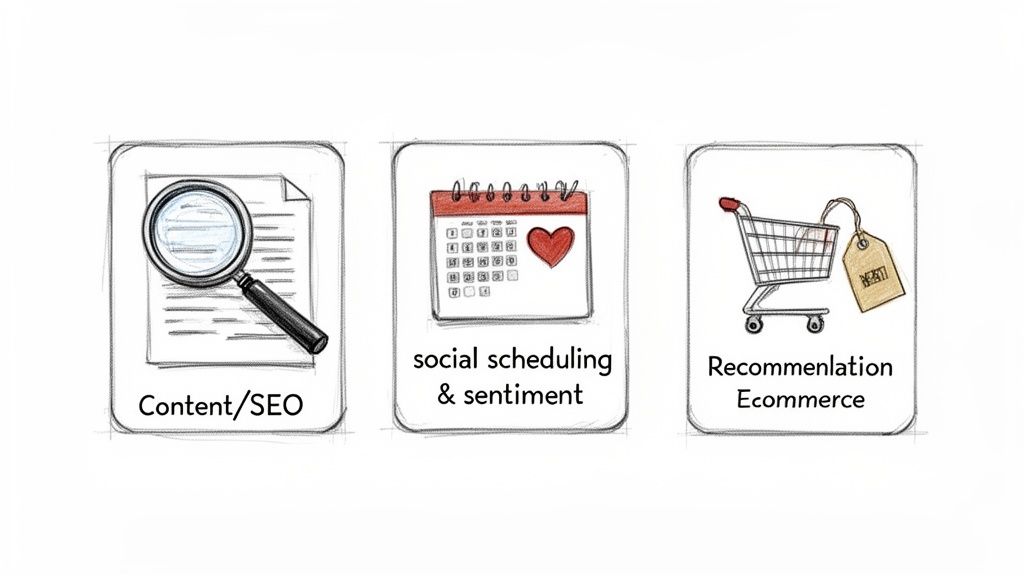
Supercharge Your Content and SEO Strategy
Getting your content seen is a never-ending slugfest. You’re up against millions of other articles, blog posts, and videos, all screaming for attention. AI is like having a secret weapon that helps you cut through the chaos and create content that both Google and actual humans will adore.
Instead of throwing spaghetti at the wall to see what topics stick, AI tools can dissect what your competitors are doing, sniff out keyword gaps, and even spit out data-backed outlines for your next masterpiece. This completely removes the guesswork from your content calendar. Now, every piece you publish is strategically engineered to rank and pull in the right kind of audience.
If you want to really get into the weeds, exploring practical AI SEO strategies can give your search presence a serious boost.
- The Old Way: Your team burns weeks researching keywords and brainstorming topics, only to get so-so results.
- The AI Way: An AI SEO tool analyzes search trends and competitor blind spots in minutes, pinpointing high-value keywords.
- The Payoff: A data-driven content plan that churns out articles with a ridiculously high chance of ranking, driving a steady stream of organic traffic.
Revolutionize Social Media Management
Let’s be honest, running social media effectively is a 24/7 gig. Between scheduling posts, replying to comments, and putting out fires, the manual labor is enough to make anyone’s head spin. AI swoops in as your ultimate social media sidekick, handling all the tedious stuff so you can focus on what really matters: building a genuine community.
AI tools can crunch your engagement data to figure out the absolute perfect time to post for maximum reach. They can also perform sentiment analysis, scanning every mention and comment to give you a real-time vibe check on how people are feeling about your brand.
Imagine knowing instantly if your new campaign is a home run or a total dud. That’s the kind of intel that lets you pivot your messaging on the fly, and it’s exactly what AI brings to the table.
This isn't just about saving time; it's about making your entire social strategy smarter and more agile. You can double down on what’s working and snuff out problems before they blow up, all while keeping your feed buzzing with activity.
Drive E-commerce Sales with Smart Personalization
For anyone running an online store, the line between a casual browser and a paying customer is razor-thin. And that line is usually drawn with one word: relevance. Generic, one-size-fits-all shopping experiences are dead. AI is the engine powering the hyper-personalized journeys that turn window shoppers into raving fans.
Think about it. Dynamic pricing algorithms can adjust prices in real-time based on demand or what your competitors are up to. Slick recommendation engines act like a personal shopper for every single visitor, showing them products they'll love but might have never found on their own.
- Dynamic Product Recommendations: An AI system tracks a user’s clicks and past purchases to serve up a curated list of items they actually want, bumping up your average order value.
- Personalized Visuals: With an API like PixelPanda, you can automatically generate different promotional images for different customer segments, making every ad feel like it was made just for them. See what's possible by checking out the straightforward PixelPanda pricing plans.
- Predictive Churn Prevention: AI can flag customers who are about to bail and automatically send them a targeted discount or special offer to reel them back in.
This kind of tech isn't just for the Amazons of the world anymore. These are accessible tools that can give any online store a massive competitive advantage. And the budget impact is huge—marketers are wasting up to 30% of their budgets on ads that just don't work. AI is changing that, with 46% of teams now using it to scale creative production and a whopping 95% testing it for creative tasks.
How to Automate Visuals with PixelPanda
Visual content is the engine of modern marketing. But let's be real—creating it can be a soul-crushing bottleneck. Behind every slick ad or perfect product shot are hours upon hours of tedious, manual editing. This is exactly where specialized AI marketing tools are changing the game, not just by speeding things up, but by completely rewriting the rules.
Let’s meet three professionals trapped in this very loop. Sarah, an e-commerce manager, is drowning in thousands of product photos, all with inconsistent, messy backgrounds. Ben, a social media marketer, is scrambling to create enough ad variations to keep his campaigns from going stale. And Chloe, a developer, has been tasked with building a complex image processing feature into her company’s app—a project that’s quickly turning into a logistical nightmare.
Each of them is staring down a different version of the same monster: the sheer volume of visual content is overwhelming their resources and grinding their momentum to a halt.
Solving the E-Commerce Nightmare
For Sarah, the e-commerce manager, brand consistency is non-negotiable. Her marketplace is a chaotic mix of supplier images with distracting backgrounds, weird lighting, and mismatched sizes. Fixing each one by hand isn’t just slow; it’s a direct path to burnout and sloppy mistakes.
This is a classic problem where a focused AI tool absolutely shines. Instead of tying up a designer with mind-numbing background removal, Sarah can use an API to automate the whole shebang.
- Batch Background Removal: She can feed thousands of images into the system at once, getting back clean, professional cutouts with transparent backgrounds almost instantly.
- Uniform Sizing and Alignment: The API can also resize and center every single product, creating that crisp, uniform look across her entire catalog.
- Serious Time Savings: What once took weeks of manual labor is now done in hours. This frees up her team to focus on things that actually move the needle, like merchandising and strategy.
The result? A sharp, professional-looking storefront that builds trust and drives sales, all with a tiny fraction of the effort. That's the power of automating a single, high-impact visual task.
Fueling the Social Media Machine
Over in the marketing department, Ben is fighting a different battle. His audience is smart and gets bored fast. The ad creative that was a smash hit last week is already being ignored today. He desperately needs a constant stream of new visuals to test, but his design team is already maxed out.
This is where generative AI becomes his new creative co-pilot. Instead of waiting days for a new set of ads, Ben can use a text-to-image generator to spin up dozens of on-brand variations in minutes.
The workflow below shows how AI can take a single set of inputs and churn out a whole slew of ad variations, each ready for a different marketing channel.
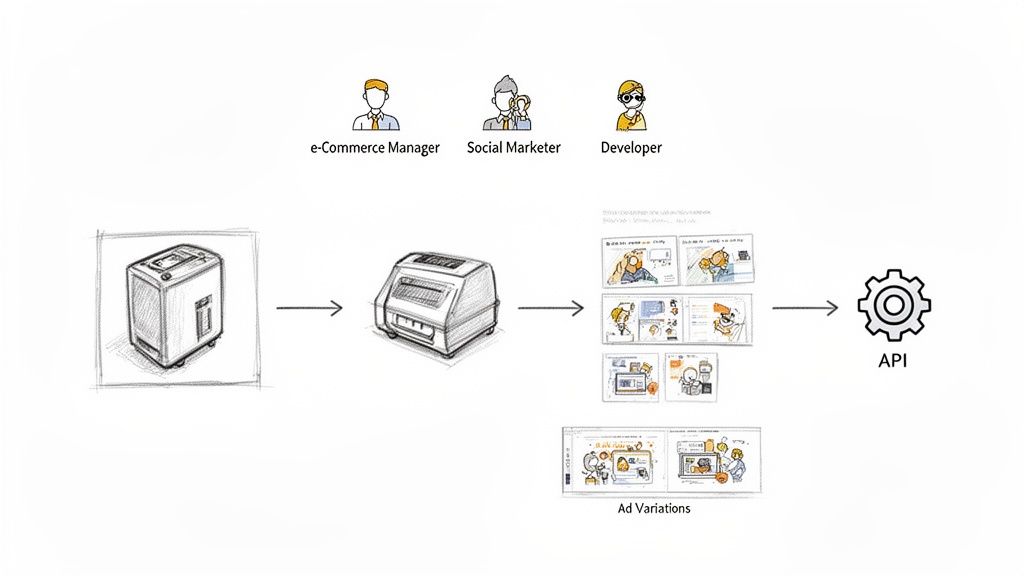
This lets marketers like Ben jump off the slow, manual hamster wheel and onto a high-speed system for testing and optimizing ad performance.
The Developer’s Secret Weapon
Finally, we have Chloe, the developer. Her mission is to build a feature that lets users upload photos, clean them up, and pop them into the app. Building this from scratch would mean wrestling with complex libraries, managing servers, and endless debugging—especially for tricky bits like hair and fur.
For her, an image processing API is the ultimate cheat code. By integrating a few lines of code, she gets instant access to a whole suite of powerful, pre-trained AI models.
A Simple API for Complex Problems:
- Painless Integration: With solid documentation and SDKs, she can hook into the API in a few hours, not weeks.
- Reliable Results: She gets studio-quality background removal, upscaling, and other tweaks without needing a Ph.D. in computer vision.
- Scales on Demand: The system is built to handle huge volumes, so she never has to worry about the feature crashing as the app gets more popular.
For all three of these pros, a specialized tool like the PixelPanda AI image API is the clear answer. It isn't just about saving time. It's about unlocking a level of scale, consistency, and creative freedom that used to be completely out of reach.
Your First Steps into AI Marketing
Jumping into AI marketing can feel like you're trying to drink from a firehose. So much tech, so many promises. But here’s the secret: you don't need to do everything at once. The smart move is to pick one leaky pipe to fix, not try to rebuild the entire plumbing system overnight.
This approach gives you a clear, manageable path forward. It turns a massive, intimidating project into a series of small, satisfying wins. Let's walk through a simple, four-step plan to get you started without the overwhelm. This isn't about boiling the ocean; it's about making a real, noticeable impact, fast.
Step 1: Pinpoint Your Biggest Bottleneck
Before you even glance at a new tool, ask your team one brutally honest question: "What’s the single most frustrating, time-sucking task we deal with every single week?"
Is it the soul-crushing grind of creating a dozen ad variations for every campaign? The black hole of manually sorting and scoring leads? Or maybe it's just the sheer guesswork that goes into planning your next content piece?
The goal here is to find the point of maximum friction. Where does work grind to a halt?
- Lead Management: Are your salespeople constantly complaining that leads are ice-cold by the time they finally get them?
- Content Creation: Does your team spend more time in Photoshop editing images than actually creating killer campaigns?
- Ad Optimization: Is your ad budget a mystery box where money goes in but clear results don't always come out?
Your answer is your starting point. When you focus on a single, high-pain area, your first AI project is guaranteed to deliver an immediate improvement that gets everyone on board and excited for what's next.
Step 2: Research and Select the Right Tool
Okay, you’ve identified the bottleneck. Now it’s time to find the right tool for that specific job. Don't get distracted by shiny platforms that promise to do everything for everyone. You're looking for a specialist, not a jack-of-all-trades.
Create a simple checklist to keep your search focused. A genuinely useful tool should tick these boxes:
- Easy Integration: Does it play nice with the software you already depend on, like your CRM, e-commerce platform, or CMS?
- User-Friendliness: Can your team actually use it without needing a computer science degree? If it’s too complex, it’ll just collect dust.
- Scalability: Can it grow with you, or will you be looking for a replacement in six months?
For example, if your biggest headache is creating visual assets at scale, you can explore demos of AI image editing tools. This lets you see firsthand how they can automate tedious tasks like background removal or generate a mountain of creative assets in minutes.
Step 3: Launch a Small-Scale Pilot Project
Time to test the waters. A pilot project is your secret weapon—a low-risk way to prove AI's value before you ask for a bigger budget. Pick a small, self-contained part of your workflow and apply your chosen tool to it.
A pilot project isn't just a test; it's your internal marketing campaign for AI. Your goal is to generate a success story that you can use to get buy-in from the rest of the company.
For instance, if you’re testing an AI ad creation tool, don’t tear up your entire strategy. Just run one A/B test campaign. Pit the AI-generated visuals directly against your best human-made assets. This gives you clean, undeniable data on what works.
Step 4: Measure, Iterate, and Scale Up
The final step is to measure what happened. Track the key metrics that actually matter for your pilot. This isn't about collecting flashy numbers; it’s about building a rock-solid business case.
Look at both the hard and soft returns on your experiment:
- Return on Investment (ROI): Did the AI-powered campaign generate more revenue or better leads for less money?
- Time Saved: How many hours did the tool give back to your team? (This is a huge one!)
- Conversion Lift: Did you see a measurable, meaningful bump in your click-through or sign-up rates?
Use these results to fine-tune your approach. Once you’ve proven the value in a small way, you'll have all the evidence you need to confidently scale the solution across your entire department.
Got Questions About AI Marketing? We've Got Answers.
Jumping into AI marketing can feel a bit like learning a new language—you know it's powerful, but you're not quite sure what all the words mean. Let's tackle some of the biggest questions on everyone's mind so you can get started without the guesswork.
Is a Robot Coming for My Marketing Job?
Let’s get this one out of the way: no. AI isn't here to replace you; it's here to give you superpowers. Think of it as the ultimate assistant, the one who happily takes on the mind-numbing, repetitive work that eats up your day.
Sorting through endless spreadsheets? Manually tweaking ad bids? Let the machine handle it. This frees you up to do what humans do best: dream up big-picture strategy, tell compelling stories, forge real connections with customers, and make those critical gut-check decisions. It's less of a replacement and more of a promotion—from task-doer to chief strategist.
Is AI Marketing Just for the Big Guys with Deep Pockets?
That might have been the case a few years back, but not anymore. The game has totally changed. Thanks to a boom in user-friendly software and affordable APIs, powerful AI tools are now fair game for everyone.
Many of these platforms offer flexible, pay-as-you-go pricing and even generous free tiers. This means a startup or a small e-commerce shop can dip their toes in the water with a single, high-impact project—like automatically generating product images or personalizing a welcome email series—and scale up once the results start rolling in.
The old myth that AI is an enterprise-only luxury is officially busted. It’s now about finding the right tool for your most pressing problem, no matter how big or small your team is.
How Do I Actually Measure the ROI of This Stuff?
Great question. Measuring the return on your AI investment isn't just about one number; it's about looking at both the hard data and the operational efficiencies you gain. The key is to take a snapshot of your performance before you flip the switch, giving you a clear "before and after" story to tell.
Here’s what to track:
- Quantitative Wins: These are your classic bottom-line metrics. Are you seeing higher conversion rates? Is your cost-per-acquisition (CPA) dropping? Is your customer lifetime value (CLV) on the rise? These are the numbers that make executives smile.
- Qualitative Wins: Don't sleep on the "soft" benefits, because they add up fast. How many hours is your team getting back each week from automation? Are you launching campaigns faster? Is your branding more consistent because AI is handling the creative grunt work?
When you combine both, you get a 360-degree view of the value AI brings to the table, making it a no-brainer to justify.
Ready to stop wasting time on manual visual production? With PixelPanda, you can automate everything from background removal to generating thousands of ad creatives, freeing your team to focus on growth. Try the PixelPanda API for free.