Artificial intelligence is no longer a futuristic concept; it's a core component of the modern marketing engine. AI tools are essential for automating repetitive tasks, generating data-driven insights, and creating compelling content at scale. They empower teams to work smarter, faster, and more effectively, driving measurable results and freeing up valuable time for strategic initiatives.
But with a rapidly growing landscape of options, identifying the right solutions can be overwhelming. This guide cuts through the noise. We've compiled a curated and comprehensive list of the best AI tools for marketers to help you build a high-performance stack. This shift towards accessible AI is also heavily influenced by user-friendly systems that don't require deep technical knowledge. To further explore the emerging technological landscape that enables this transformation, consider delving into the 12 Best No-Code AI Platforms to Watch in 2025.
Our goal is to provide a practical resource, not just a list. For each tool, we offer:
- Actionable insights and honest assessments of strengths and weaknesses.
- Specific use-case scenarios for different team types, from e-commerce sellers to SaaS platforms.
- Key details on pricing, integrations, and implementation tips.
- Screenshots and direct links to help you evaluate each platform efficiently.
We'll explore platforms for everything from advanced SEO and content creation to visual production and workflow automation. You'll find tools like Jasper for copywriting, Semrush for analytics, and PixelPanda for automating high-volume visual content. Let's dive in and find the perfect AI solutions to upgrade your marketing toolkit for 2025 and beyond.
1. PixelPanda
Best For: Automated, high-volume visual production and API integration.
PixelPanda stands out as one of the best AI tools for marketers by providing a powerful, API-first platform for automated image processing. While many tools offer singular functions like background removal, PixelPanda consolidates a suite of advanced editing capabilities into a single, scalable workflow. This makes it an invaluable asset for e-commerce brands, marketing agencies, and development teams that need to produce studio-quality visuals without the manual overhead.
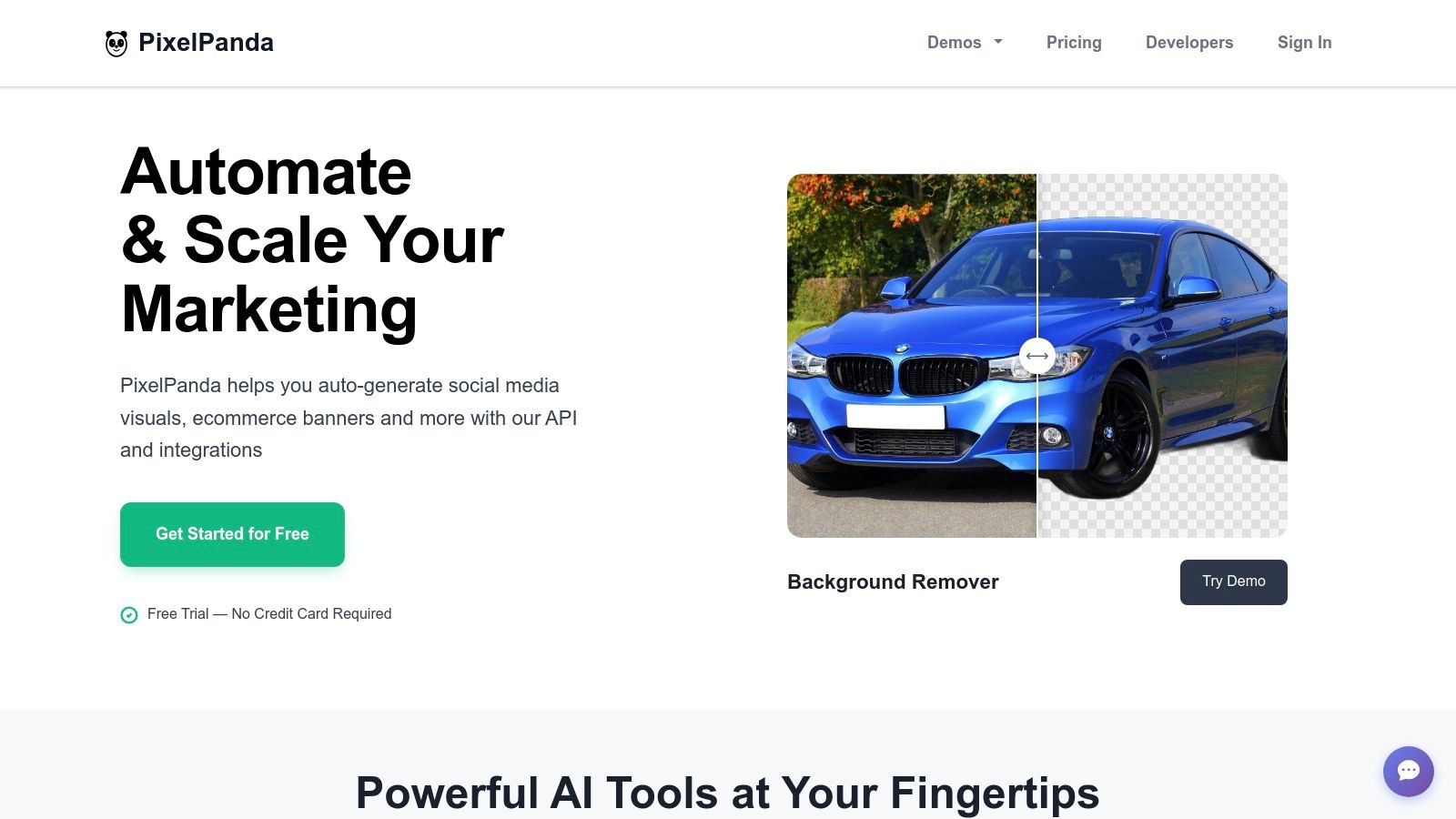
Its core strength lies in its precision and versatility. The AI models are expertly trained to handle complex subjects, such as isolating fine hair or fur against busy backgrounds, which often challenge other tools. The platform combines background removal with smart inpainting, 4x upscaling, and face enhancement to deliver clean, professional results in seconds.
Key Features and Use Cases
- Automated E-commerce Catalogs: Use the batch processing capabilities to remove backgrounds from thousands of product photos, ensuring a consistent, clean look for online stores and marketplaces.
- Dynamic Social Media Content: Integrate the API to automatically generate branded social media banners, promotional images, and ad creatives by layering text and graphics onto clean product cutouts.
- High-Quality Image Enhancement: Leverage the 4x upscaler and content-aware fills to restore old photos, improve user-generated content, or enhance listing photos to meet high-resolution standards.
Why It's a Top Choice
PixelPanda is built with developers in mind. Its simple REST API, comprehensive documentation, and language-specific SDKs allow for straightforward integration into existing applications and workflows. Teams report being able to implement the API in minutes, not days. While pricing is not public, the platform offers a generous free trial without requiring a credit card, allowing teams to fully test its capabilities risk-free. This combination of studio-grade output, scalability, and developer-friendly design makes it an essential tool for modern marketing operations.
- Website: https://pixelpanda.ai
- Pricing: Custom pricing available upon signing up for a free trial or contacting sales.
- Best For: Teams needing to automate visual content creation at scale, particularly e-commerce, and developers integrating image processing into apps.
2. G2
G2 isn't an AI tool itself, but rather an indispensable research platform for marketers vetting the crowded landscape of AI software. It serves as one of the largest B2B software marketplaces, offering a comprehensive starting point to discover, compare, and select the best AI tools for marketers based on extensive, verified user reviews.
The platform’s strength lies in its structured data. Instead of wading through endless blog posts, you can dive directly into specific categories like "AI Content Creation" or "AI Chatbots." G2’s proprietary Grid® reports visually map out tools based on user satisfaction and market presence, giving you an instant snapshot of category leaders and high-momentum products. This data-driven approach helps teams move beyond marketing hype and evaluate tools on real-world performance.
Key Strengths & Considerations
The primary value of G2 is its moderated review system. Reviews are verified, and you can filter them by company size, industry, and user role, ensuring the feedback is relevant to your specific context. This helps you understand how a tool performs for a small marketing agency versus a large enterprise team.
However, be mindful that sponsored placements can influence which vendors appear at the top of category pages. While these are clearly marked, it's a factor to consider. For rapidly evolving AI fields, you might also find relevant tools split across several different G2 categories, requiring a bit more exploration.
Pro Tip: Use the comparison feature to select up to four tools and generate a side-by-side analysis of features, pricing, and satisfaction ratings. This is the fastest way to build a shortlist.
- Primary Use Case: Researching and comparing AI marketing tools before a demo or purchase.
- Ideal For: Marketing leaders, operations managers, and procurement teams tasked with software evaluation.
- Pricing: Free to browse and compare. Vendors pay for enhanced profiles and intent data.
- Website: https://www.g2.com
3. GetApp (Gartner Digital Markets)
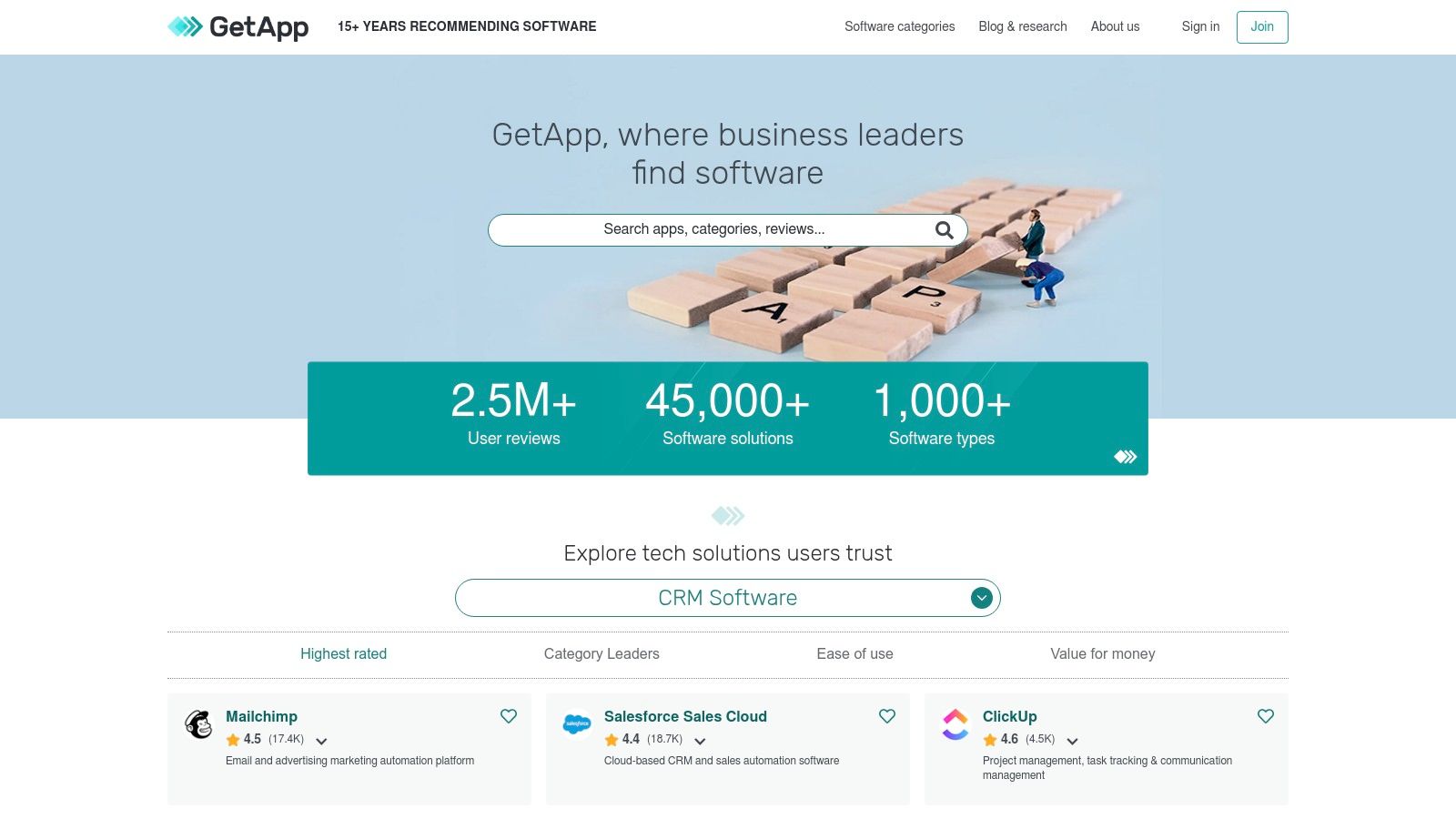
Like G2, GetApp is not a standalone AI tool but a robust software discovery platform that helps professionals find the right applications for their business. As part of the Gartner Digital Markets network, it offers a well-maintained directory with dedicated categories and filters specifically for AI Marketing Tools, making it an excellent resource for identifying and shortlisting potential solutions.
Its core advantage is the clarity and accessibility of its filtering system. You can quickly narrow down the vast field of the best AI tools for marketers by features, pricing models (e.g., free trial, freemium), integrations, and device compatibility. This makes GetApp particularly useful for teams that have a clear set of technical or budgetary requirements from the outset.
Key Strengths & Considerations
GetApp excels at providing at-a-glance information, especially with its "Category Leaders" rankings and clear pricing snippets. The platform often displays starting prices and available free trials directly on the list pages, saving you countless clicks when doing initial market research. The user interface is clean and focused on efficient comparison.
However, like other software marketplaces, sponsored vendor placements can affect visibility, so it's wise to look beyond the top-listed options. Additionally, while the breadth of listings is impressive, some of the newer or more niche AI tools may lack the deep, hands-on user reviews found on more community-driven platforms.
Pro Tip: Use the "Marketing" category and then apply the "AI/Machine Learning" feature filter. This combination surfaces relevant tools that might not be listed directly under a dedicated "AI" category, helping you uncover hidden gems.
- Primary Use Case: Filtering and comparing AI marketing software based on specific features, pricing, and integrations.
- Ideal For: Small to mid-sized business (SMB) marketers and teams needing to quickly create a shortlist based on concrete requirements.
- Pricing: Free for users to search and compare software. Vendors pay for premium listings and lead generation.
- Website: https://www.getapp.com
4. Product Hunt
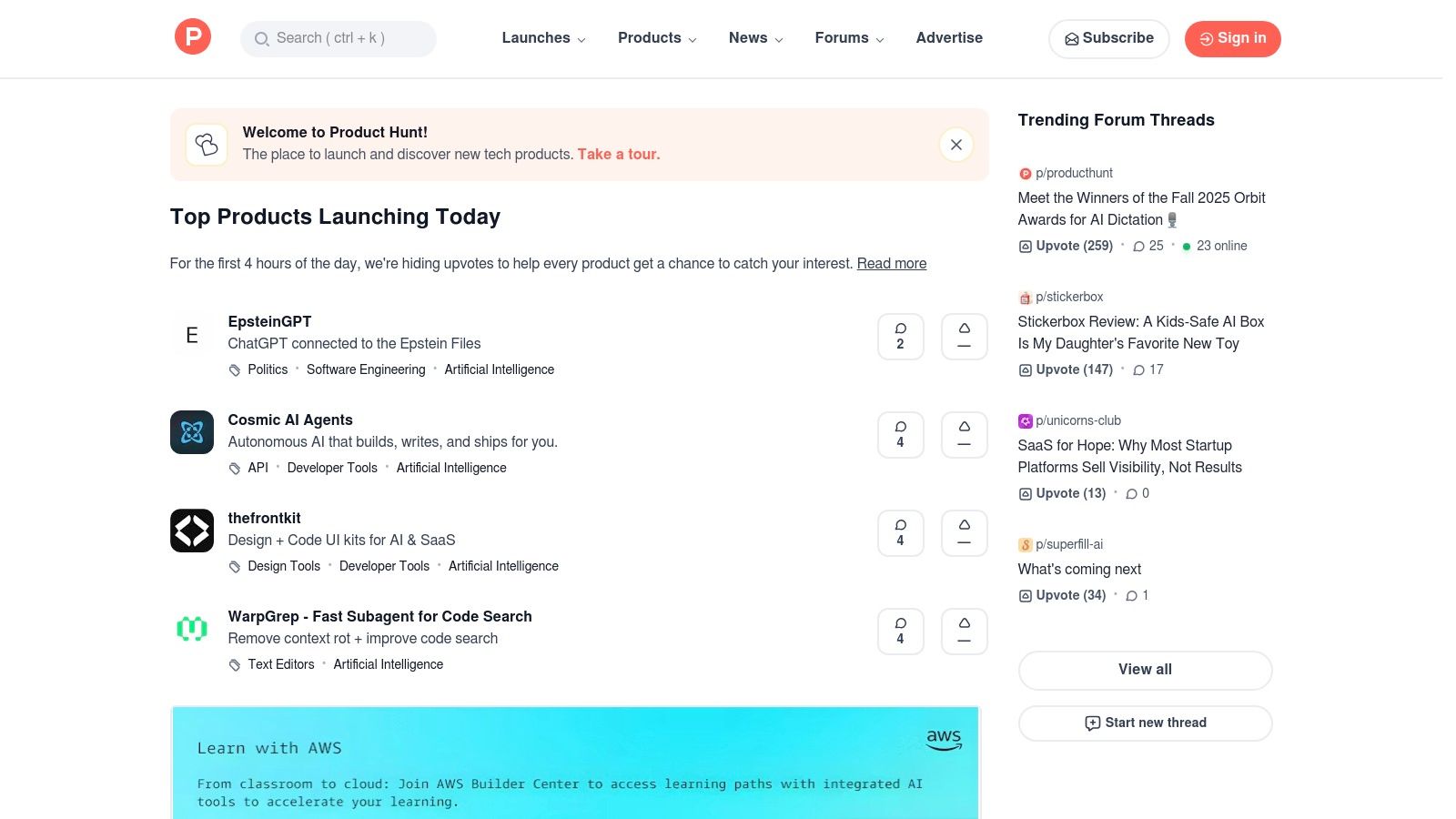
Product Hunt isn't a direct AI provider, but it functions as an essential launchpad for discovering the most innovative and emerging AI-powered applications. For marketers looking to stay ahead of the curve, it is the premier platform to find cutting-edge tools often before they appear on larger review sites, making it a critical resource for finding the best AI tools for marketers as they launch.
The platform thrives on community curation, where new tools are "hunted" and voted on by users. This social proof mechanism, combined with direct feedback from founders in the comments, provides a real-time pulse on what's new and gaining traction in the marketing tech world. You can explore daily leaderboards, curated collections, and newsletters focused specifically on AI.
Key Strengths & Considerations
Product Hunt’s primary advantage is providing an early signal on groundbreaking technology. The community-driven feedback offers authentic, initial impressions and allows you to ask questions directly to the creators. This direct line of communication is invaluable for understanding a tool's vision and potential roadmap.
However, the platform’s focus on newness means that many tools are nascent and not yet enterprise-tested. The "upvote" system can sometimes be driven by hype rather than proven, long-term value, and you won’t find the deep, structured comparison data available on platforms like G2. It’s a discovery engine, not an exhaustive evaluation database.
Pro Tip: Subscribe to the Product Hunt daily or weekly newsletters and filter for "Artificial Intelligence" and "Marketing" tags. This is the most efficient way to get a curated digest of relevant new tool launches delivered directly to your inbox.
- Primary Use Case: Discovering new and trending AI marketing tools at the moment of their launch.
- Ideal For: Innovative marketing teams, tech-savvy founders, and strategists wanting to be early adopters.
- Pricing: Free to browse and discover products.
- Website: https://www.producthunt.com
5. AppSumo
AppSumo isn't a single AI tool but a deal-driven marketplace where marketers can discover emerging SaaS products, often at a significant discount. It’s a treasure trove for finding and experimenting with the best AI tools for marketers without committing to expensive annual subscriptions. The platform specializes in lifetime deals (LTDs), allowing teams to purchase software licenses with a one-time payment.
The primary appeal for marketing teams is the ability to build a robust, budget-friendly tech stack. You can find everything from AI-powered copywriting and SEO analysis tools to AI video editors and social media schedulers. Because the deals are time-limited, the platform encourages quick adoption and experimentation, making it an excellent resource for agile teams looking to test new workflows or find a niche solution for a specific campaign.
Key Strengths & Considerations
AppSumo’s key advantage is its low-risk trial model. Every deal comes with a 60-day money-back guarantee, giving you ample time to integrate a tool and evaluate its real-world value. The community review and question sections on each product page are also invaluable, providing candid feedback from other marketers who have already tested the software.
However, the "you get what you pay for" principle can sometimes apply. The versions of software offered in LTDs may have feature limitations or lower usage caps compared to standard subscription plans. Furthermore, because deals are temporary, you can't rely on a specific tool being available when you need it. Long-term support for a product purchased years ago can also be a consideration.
Pro Tip: Don't just look at the features; scrutinize the user reviews and the Q&A section on the deal page. Pay close attention to the founder's responsiveness, as it’s a good indicator of long-term product support.
- Primary Use Case: Discovering and acquiring marketing software, including many AI tools, on lifetime or heavily discounted deals.
- Ideal For: Small businesses, freelance marketers, and agencies looking to build a powerful toolset on a limited budget.
- Pricing: Varies per deal; typically one-time payments for lifetime access.
- Website: https://appsumo.com
6. Shopify App Store (Marketing + AI)
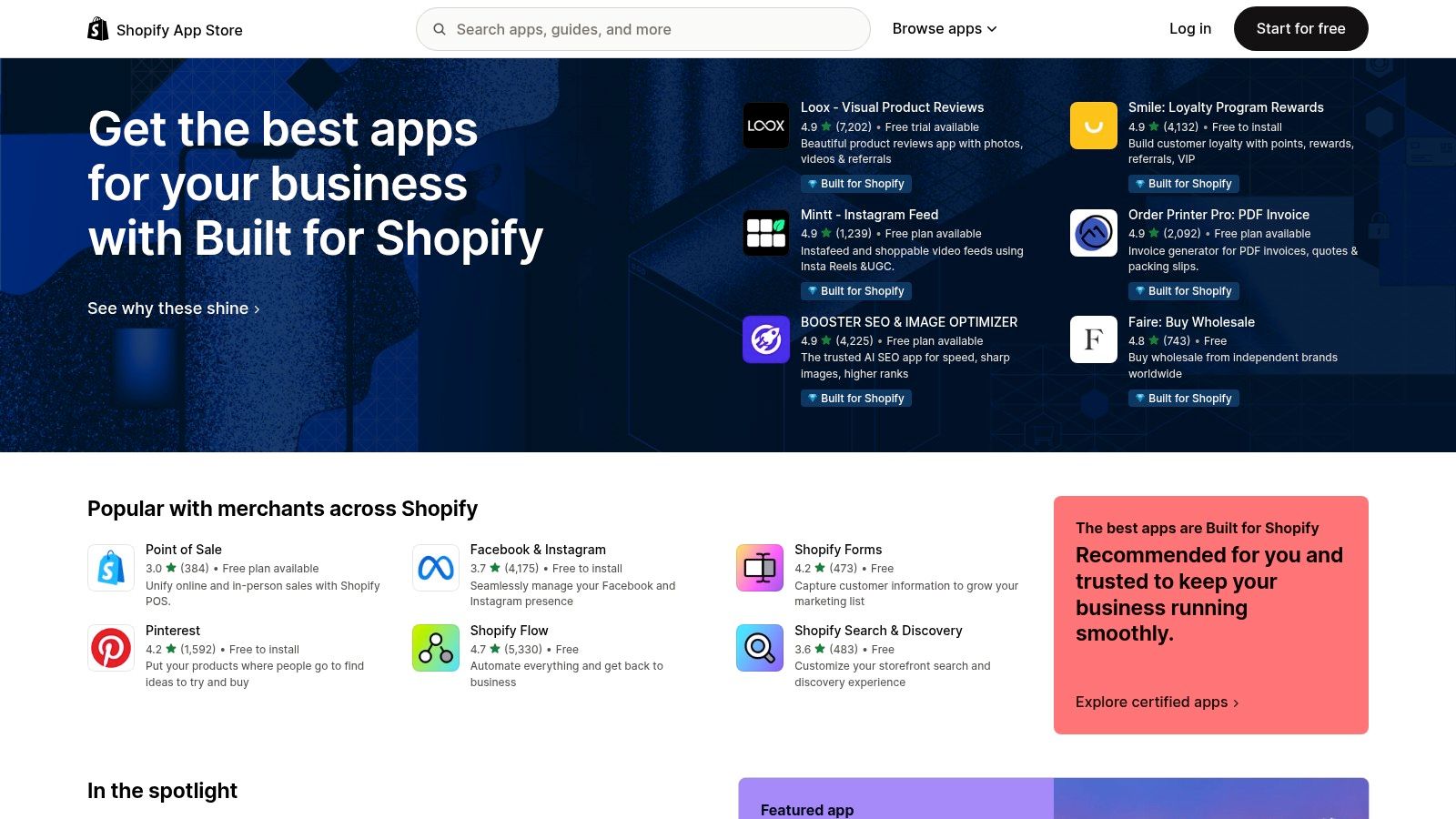
For marketers operating in the direct-to-consumer space, the Shopify App Store is less of a single tool and more of a specialized ecosystem. It's an indispensable marketplace where merchants can discover and integrate hundreds of AI-powered marketing applications directly into their online stores. This platform is a critical resource for finding the best AI tools for marketers built specifically for the nuances of e-commerce.
The store’s main advantage is its deep, one-click integration. You can find AI tools for everything from generating product descriptions and managing ad campaigns to automating email sequences and creating personalized customer journeys. Instead of vetting standalone SaaS products, Shopify merchants can find solutions designed to work seamlessly with their existing sales data, customer profiles, and marketing channels, significantly reducing implementation friction.
Key Strengths & Considerations
The core value of the Shopify App Store lies in its verified merchant reviews and simple billing. You can gauge an app's real-world performance based on feedback from other store owners, and all charges are consolidated into your monthly Shopify bill. Many visual marketing apps, such as those for AI-driven product photo background removal, can be found and installed within minutes.
However, the quality of apps can vary widely, requiring careful vetting. While many apps offer free trials, some can become quite expensive as your business scales, adding significant operational costs. It is crucial to read recent reviews and understand the pricing tiers before committing to an app.
Pro Tip: Look for apps with a "Built for Shopify" badge. This signifies they meet a higher standard for performance, security, and user experience set by Shopify itself.
- Primary Use Case: Adding specialized AI marketing functions directly to a Shopify e-commerce store.
- Ideal For: E-commerce marketers, DTC brand owners, and Shopify store managers.
- Pricing: Varies by app; many offer free plans, free trials, or usage-based pricing.
- Website: https://apps.shopify.com
7. HubSpot App Marketplace (AI for HubSpot)
For marketing teams already embedded in the HubSpot ecosystem, the HubSpot App Marketplace is the most logical and efficient starting point for expansion. It functions as a dedicated ecosystem for certified applications designed to natively integrate with HubSpot’s CRM, Marketing Hub, and other tools, making it an essential resource for finding the best AI tools for marketers that guarantee data synergy.
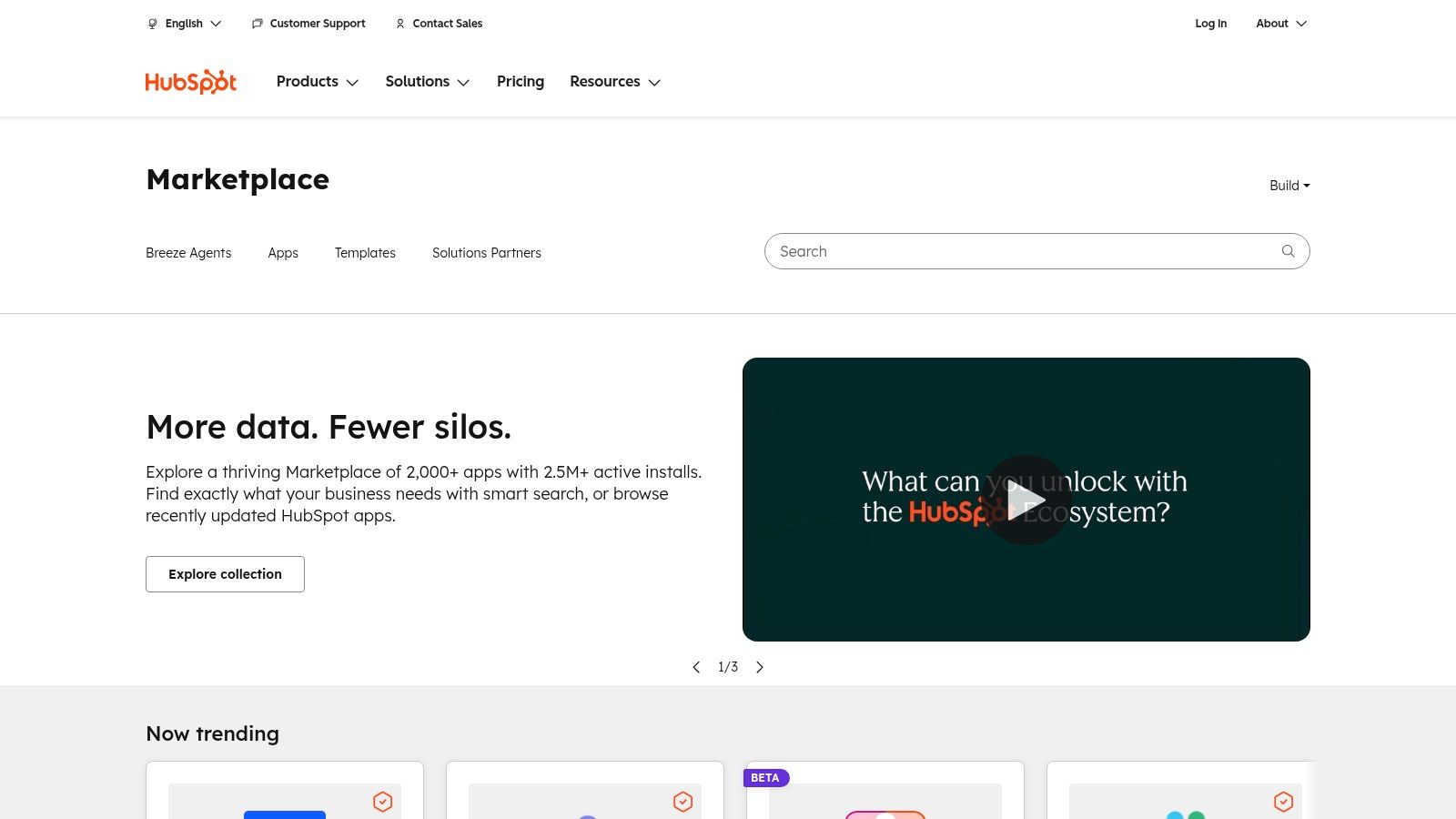
Unlike broad-based marketplaces, this platform offers a curated experience. You can easily find AI-powered content creators, workflow automation agents, and predictive lead scorers that plug directly into your existing HubSpot workflows. The direct integration eliminates the common friction of data silos and complex API setups, allowing marketers to activate new capabilities with minimal technical overhead.
Key Strengths & Considerations
The primary advantage is the seamless data flow. When an AI app is HubSpot-certified, you can trust it to read from and write to your CRM contacts, deals, and company records without issue. Each listing clearly outlines its prerequisites, pricing, and security posture, providing the transparency needed for confident decision-making.
However, many of the more innovative AI apps may be new and have a limited number of user reviews, requiring a bit more due diligence. Additionally, the full value of these applications is inherently tied to your HubSpot subscription tier; a powerful AI tool might require a Professional or Enterprise plan to function, which is a crucial budget consideration.
Pro Tip: Filter apps by "HubSpot-built" or "Certified App Partner" to prioritize solutions with the highest level of integration and support. Check the "Required Subscriptions" section on any listing before installing.
- Primary Use Case: Extending HubSpot’s functionality with AI for content creation, workflow automation, and data analysis.
- Ideal For: Marketing teams and RevOps professionals who use HubSpot as their central source of truth.
- Pricing: Free to browse. App pricing varies from free tiers to per-user or usage-based subscriptions.
- Website: https://ecosystem.hubspot.com
8. Salesforce AppExchange (Marketing + AI)
For marketing teams deeply embedded in the Salesforce ecosystem, the AppExchange isn't just an app store; it's a critical launchpad for integrating AI capabilities directly into their CRM and marketing automation workflows. It functions as an enterprise-grade marketplace where you can find vetted AI-enhanced applications for everything from predictive lead scoring and account-based marketing (ABM) to hyper-personalization and campaign attribution, all built to seamlessly connect with your existing Salesforce data.
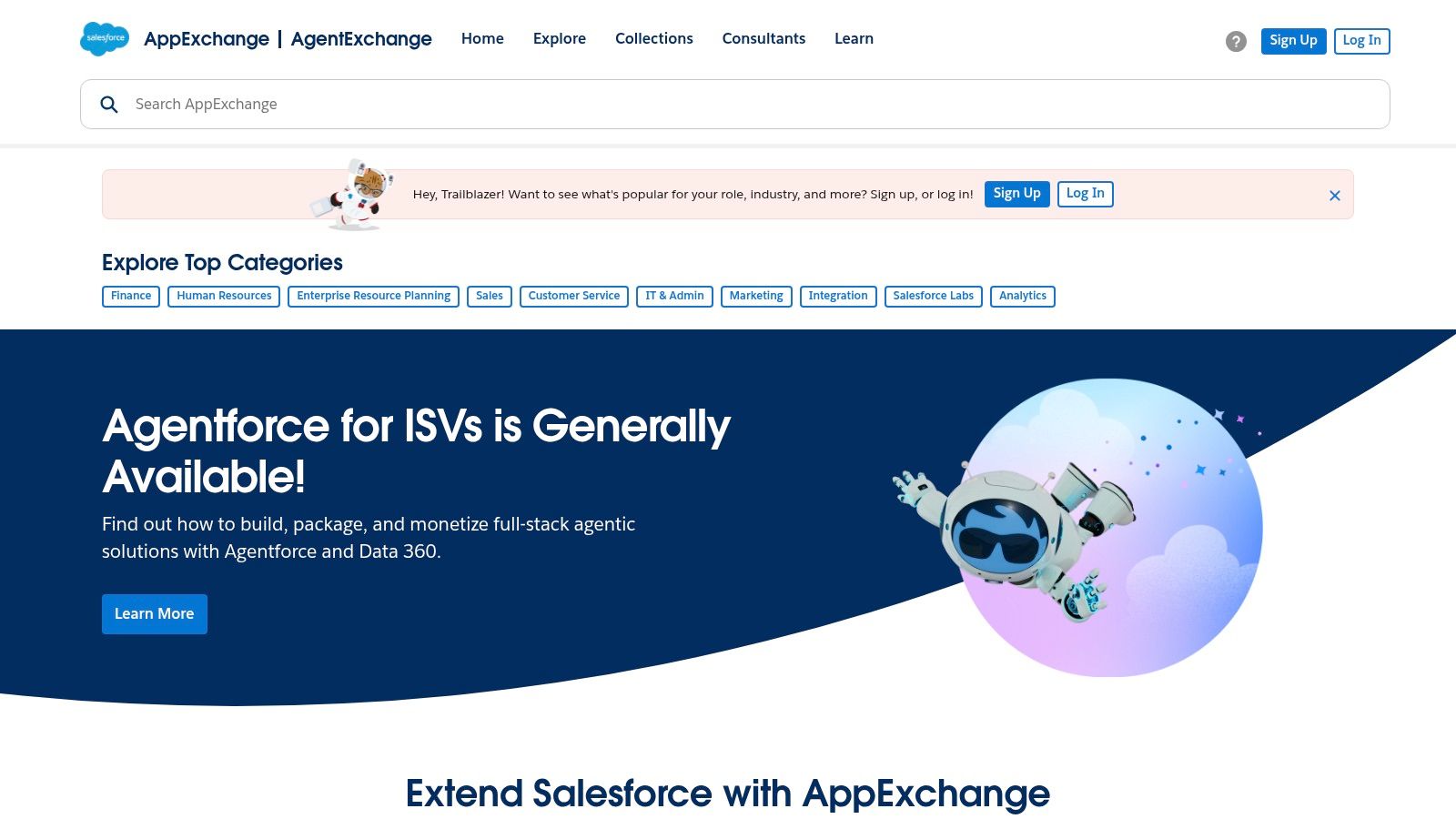
The platform’s core advantage is its rigorous security review process. Every application listed must pass Salesforce’s strict security and governance standards, significantly reducing the risk associated with adopting new AI tools. This allows marketing teams to discover and implement some of the best AI tools for marketers with confidence, knowing they are pre-vetted for enterprise use and designed to work natively within their core operational environment.
Key Strengths & Considerations
The AppExchange excels at providing deep, native integrations that generic AI tools can't match. This means AI-driven insights from an installed app can directly trigger actions in Marketing Cloud, update records in Sales Cloud, or enrich customer profiles without complex API work. You are essentially extending your CRM's intelligence rather than bolting on a separate system.
However, this is an enterprise marketplace, and its processes reflect that. Many apps do not have transparent, click-to-buy pricing and require engaging with a sales team. Costs are often calculated on a per-user, per-month basis, which can become a significant investment for large marketing departments.
Pro Tip: Use the "Test Drive" feature when available. It provides a pre-configured, read-only Salesforce org with the app installed, allowing you to experience the user interface and core features without a full installation.
- Primary Use Case: Discovering and deploying vetted, enterprise-ready AI marketing apps that integrate directly with Salesforce.
- Ideal For: Marketing operations leaders and Salesforce administrators in mid-market to enterprise companies.
- Pricing: Varies widely from free to enterprise contracts. Many require custom quotes.
- Website: https://appexchange.salesforce.com
9. Google Workspace Marketplace (Marketing/Docs/Sheets Add‑ons)
Instead of adopting an entirely new platform, marketers can infuse AI directly into their existing Google ecosystem via the Workspace Marketplace. This extensive library offers hundreds of specialized add-ons that bring AI-powered capabilities into Gmail, Docs, Sheets, and Slides. It's an incredibly efficient way to enhance familiar workflows, from generating email copy in Gmail to creating content briefs in Docs.
The marketplace serves as a powerful entry point to leverage some of the best AI tools for marketers without the friction of context switching. You can find add-ons for nearly any task, including SEO analysis inside Sheets, automated slide generation in Slides, or sophisticated copywriting assistance that taps into models like Gemini and GPT-4 directly within your documents. This transforms everyday tools into intelligent marketing assistants.
Key Strengths & Considerations
The primary advantage is low-friction adoption. Installing an add-on is simple, and it allows teams to experiment with AI without committing to another standalone subscription or learning a new interface. For larger organizations, Google Workspace admins can even deploy specific add-ons across the entire team, ensuring consistent tool access and governance.
However, the quality and feature depth can vary significantly between different add-ons. Many operate on a freemium model with tight usage caps or aggressive paywalls on their free tiers, which can quickly become a limitation for heavy use. Vetting each add-on's permissions and reviews is crucial before installation.
Pro Tip: Look for add-ons that integrate with multiple large language models (like Gemini, GPT, and Claude). This gives you more flexibility and power directly within your Google Docs or Sheets.
- Primary Use Case: Adding AI copywriting, data analysis, and content generation features into existing Google Workspace apps.
- Ideal For: Marketing teams deeply embedded in the Google ecosystem who want to enhance productivity without adding new standalone tools.
- Pricing: Varies by add-on. Many offer a free tier with usage limits, with paid plans for higher volume.
- Website: https://workspace.google.com/marketplace
10. Jasper (official site)
Jasper is a marketing-focused AI platform designed to create on-brand content and orchestrate entire campaigns. Moving beyond simple text generation, it offers a suite of marketing-tuned templates, campaign "Apps," and agent capabilities that help teams align all outputs with specific brand guidelines and audience personas.
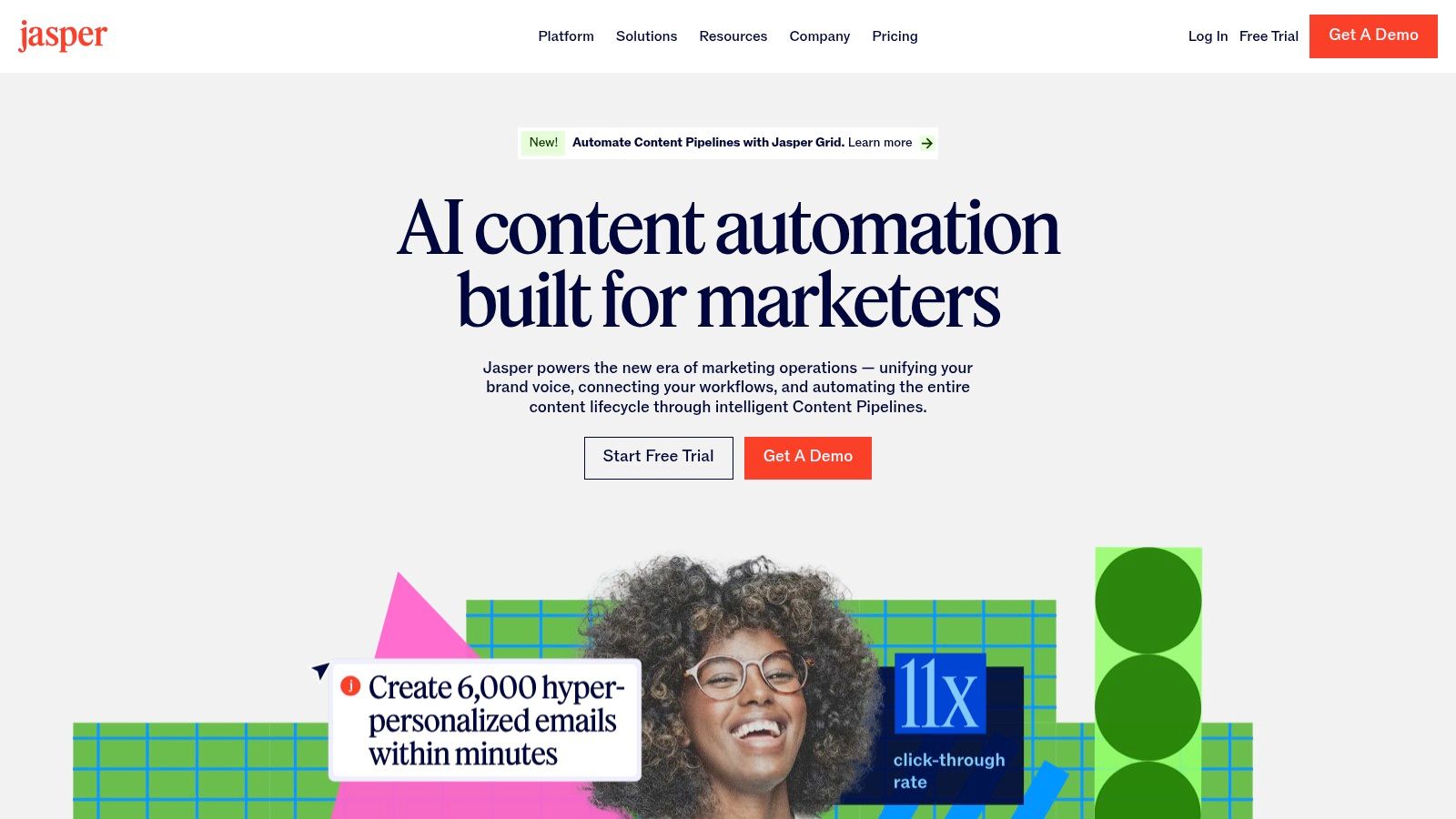
The platform's core advantage is its deep focus on brand consistency. Features like Brand Voices, Audiences, and Knowledge allow you to train the AI on your style guides, product catalogs, and target customer profiles. This ensures that whether you're drafting a blog post, social media update, or ad copy, the result feels like it came from your team, not a generic algorithm. For teams scaling content production, this is a critical differentiator.
Key Strengths & Considerations
Jasper's architecture is built specifically for marketing workflows. Its multi-model routing system enhances quality and uptime by selecting the best model for a given task, providing reliability for business-critical operations. The platform also offers a no-code AI App Builder on its Business tier, enabling teams to create custom internal tools and workflows without engineering support.
The primary drawback is the pricing model, which is per-seat and can become costly for larger teams. Furthermore, many of the most powerful features, including the API and advanced brand controls, are reserved for the higher-tier Business plan. This makes the entry-level plans less suitable for teams needing deep customization and integration.
Pro Tip: Before committing, use the free trial to thoroughly test the Brand Voice and Knowledge features. Upload your style guide and a few key product documents to see how well it adapts to your specific brand identity.
- Primary Use Case: Creating on-brand marketing copy, content, and entire campaigns at scale.
- Ideal For: Marketing teams in mid-to-large companies, content agencies, and businesses focused on maintaining strong brand consistency.
- Pricing: Tiers for Teams (starting at $99/month for 3 seats) and Business (custom pricing). A free trial is available.
- Website: https://www.jasper.ai
11. Canva Magic Studio (official site)
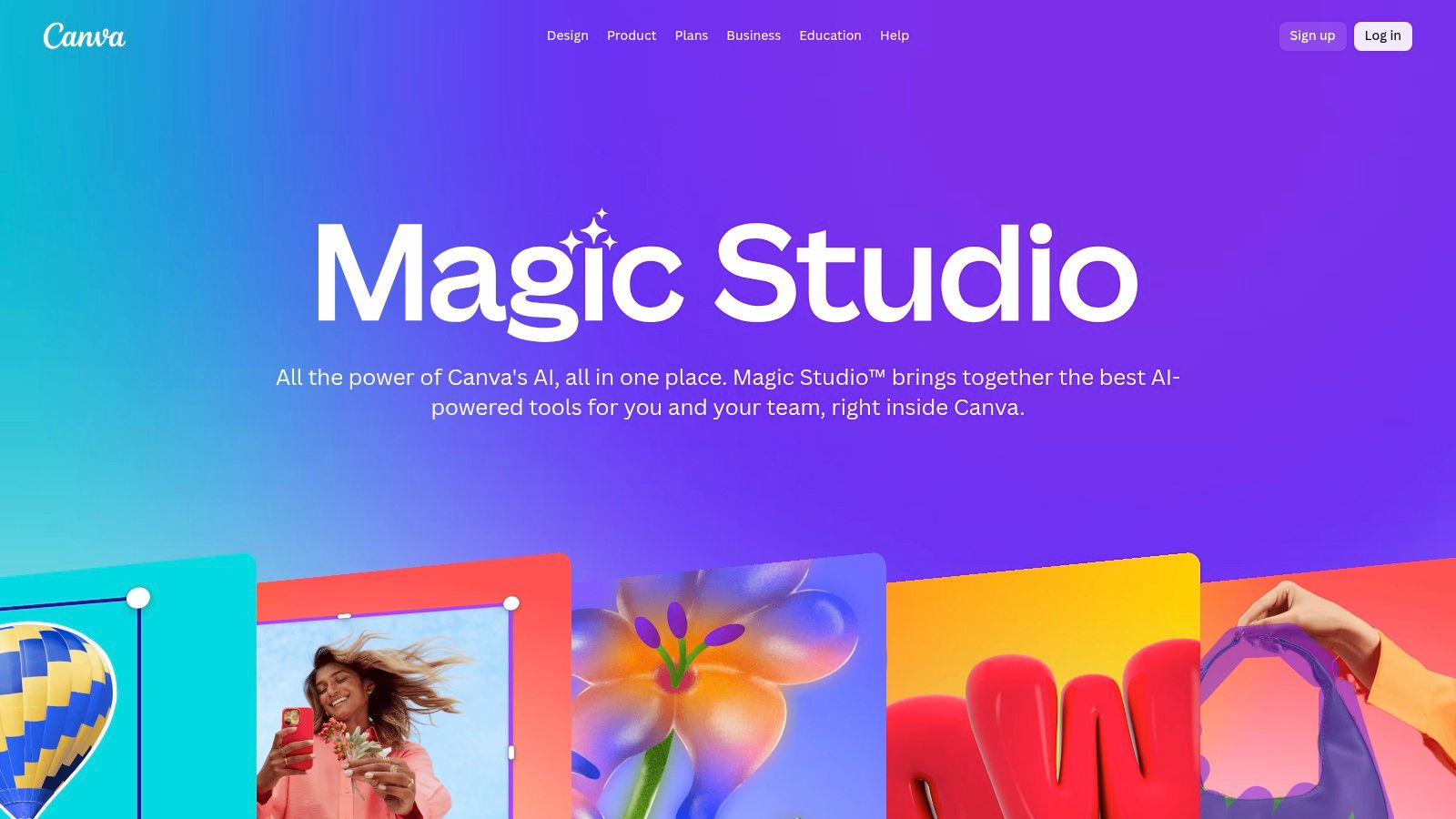
Canva Magic Studio integrates a powerful suite of AI features directly into the familiar, user-friendly Canva interface that millions of marketers already use. It’s not a standalone tool, but a collection of AI-powered capabilities designed to accelerate the creation of social media posts, ads, and presentations. This makes it one of the best AI tools for marketers who need to produce a high volume of branded creative assets without a steep learning curve.
The platform excels by embedding AI directly into the design workflow. With features like Magic Write for AI-generated copy and Magic Design for instant template creation from a prompt or media, marketers can go from a simple idea to a finished design in minutes. It streamlines the entire process, from ideation and copywriting to visual creation and team collaboration.
Key Strengths & Considerations
Canva's primary strength is its accessibility. The AI tools are intuitive for non-designers, allowing entire marketing teams to maintain brand consistency using shared Brand Kits, templates, and asset libraries. The workflow is seamless, covering everything from initial design to scheduling content with the built-in planner. This end-to-end functionality within one platform is a significant efficiency gain.
However, professionals may find the creative control less granular than dedicated design software like Adobe Photoshop. While the AI features are powerful, some of the most advanced capabilities are reserved for paid plans. For projects requiring highly detailed image enhancements, marketers may need to explore specialized tools for tasks like advanced image upscaling before importing assets into Canva.
Pro Tip: Use Magic Switch to instantly transform a single design into multiple formats. A presentation can become a blog post, and an Instagram post can be resized for LinkedIn and a Pinterest Pin with just one click, saving hours of manual resizing.
- Primary Use Case: Rapidly creating on-brand marketing and social media visuals with AI assistance.
- Ideal For: Social media managers, content marketers, and small business teams needing to produce creative assets at scale.
- Pricing: A free version is available with limited Magic Studio uses. Full access requires a Canva Pro or Canva for Teams subscription.
- Website: https://www.canva.com/magic/
12. Semrush (official site + App Center)
Semrush is a heavyweight SEO and digital marketing platform that has deeply integrated AI to connect content strategy directly with search performance. While known for its legendary keyword and competitor analysis tools, its suite now includes powerful AI applications like ContentShake AI and an AI Social Content Generator, making it one of the best AI tools for marketers who prioritize data-driven content.
The platform’s key advantage is its ability to ground AI-generated content in real-time SEO data. Instead of creating content in a vacuum, you can generate articles, social posts, and ad copy based on keyword opportunities, competitor rankings, and audience intent signals pulled directly from its massive database. This closes the loop between content creation and its strategic goal: ranking and converting. The App Center further extends this by allowing users to connect specialized AI tools into their core Semrush workflow.
Key Strengths & Considerations
Semrush’s primary value is producing SEO-optimized content with a high probability of ranking. ContentShake AI doesn't just write; it builds comprehensive briefs and articles structured around top-ranking content for a given keyword, complete with suggestions for tone and readability. The direct link between the AI writer and the SEO analytics suite is its unique selling proposition.
However, the cost structure can be a hurdle. Many of the most powerful AI features are part of the App Center or require higher-tier subscriptions, which can fragment expenses beyond the core platform fee. Furthermore, mastering the full suite of Semrush tools involves a significant learning curve, which may be overwhelming for teams looking for a simple, standalone AI writer.
Pro Tip: Before writing, use the "Keyword Magic Tool" to identify a target keyword. Then, input that keyword into ContentShake AI to generate a brief. This ensures your AI-generated content is aligned with a validated search opportunity from the start.
- Primary Use Case: Creating SEO-focused articles, social media content, and ad copy informed by competitor and keyword data.
- Ideal For: SEO specialists, content marketers, and digital marketing agencies who need to justify content with performance data.
- Pricing: Core plans start at $129.95/month. Many AI apps in the App Center require separate subscriptions.
- Website: https://www.semrush.com
Top 12 AI Tools for Marketers — Features & Pricing
| Product | Core features ✨ | Quality & Rating ★ | Value / Pricing 💰 | Target audience 👥 | USP / Notes |
|---|---|---|---|---|---|
| PixelPanda 🏆 | ✨ Background removal, smart inpainting, 4x upscaling, face enhancement, text→image, API/SDKs | ★★★★★ — studio‑quality, fast | 💰 Generous free trial (no card); contact for scale | 👥 Marketers, e‑commerce teams, developers | 🏆 Precision on hair/fur, edge‑preserving models, batch processing, transparent PNGs |
| G2 | ✨ Verified reviews, category grids, leader reports | ★★★★ — broad, moderated reviews | 💰 Free to use; sponsored placements possible | 👥 Buyers, procurement, shortlist teams | Large review dataset + buyer‑intent data |
| GetApp (Gartner) | ✨ Directory with filters, pricing snippets, leaderboards | ★★★★ — clear listings | 💰 Pricing visibility on many listings | 👥 SMBs to enterprise buyers | Quick filtering and indicative pricing |
| Product Hunt | ✨ Launch pages, upvotes, community comments | ★★★ — early signals/hype | 💰 Free discovery; links to demos | 👥 Early adopters, product hunters | Great for finding emerging tools & demos |
| AppSumo | ✨ Time‑boxed deals, lifetime licenses, refunds | ★★★★ — deal‑driven value | 💰 Deep discounts / limited‑time offers | 👥 Bootstrappers, marketers testing tools | Low‑risk trials and big savings for pilots |
| Shopify App Store | ✨ App listings, ratings, one‑click install, integrations | ★★★★ — merchant reviews | 💰 USD pricing; billing via Shopify | 👥 DTC merchants, store owners | Fast install + deep ecommerce integrations |
| HubSpot App Marketplace | ✨ Curated AI apps, install counts, pricing tables | ★★★★ — platform‑aligned | 💰 Pricing shown; requires HubSpot plan | 👥 Teams standardizing on HubSpot | Native CRM & workflow integrations |
| Salesforce AppExchange | ✨ Enterprise AI apps, security reviews, categorizations | ★★★★ — enterprise vetted | 💰 Enterprise pricing / procurement | 👥 Large enterprises, Martech teams | Strong governance & Salesforce integrations |
| Google Workspace Marketplace | ✨ Docs/Sheets/Gmail add‑ons, model integrations | ★★★★ — low friction | 💰 Free + paid tiers; admin deploy | 👥 Workspace‑centric teams | Seamless in‑app AI without new platforms |
| Jasper | ✨ Marketing templates, Brand Voices, API (Business) | ★★★★ — marketing focused | 💰 Per‑seat pricing; Business tier for advanced features | 👥 Content & marketing teams | Brand alignment and campaign apps |
| Canva Magic Studio | ✨ AI design, Brand Kit, collaboration | ★★★★★ — very user friendly | 💰 Freemium; Pro/Teams gated features | 👥 Non‑designers, social teams | Low learning curve; end‑to‑end creative flow |
| Semrush | ✨ AI content + SEO briefs, social generators | ★★★★ — data‑driven | 💰 Paid tiers + add‑ons | 👥 SEO & content marketing teams | AI tied directly to search data and analytics |
Integrating AI Into Your Marketing Strategy
Navigating the expansive landscape of AI can feel overwhelming, but the journey to a more intelligent, efficient marketing stack is a strategic marathon, not a sprint. We've explored a diverse range of platforms, from specialized content generators like Jasper to comprehensive SEO suites like Semrush, and even powerful visual automation engines like PixelPanda. The central theme is clear: adopting AI is not about replacing human creativity but about augmenting it, freeing your team from repetitive tasks to focus on high-impact strategy and innovation.
The tools detailed in this guide represent the pinnacle of what’s currently possible. Whether you're discovering new solutions on marketplaces like G2 and AppSumo or integrating specialized apps directly from the HubSpot or Salesforce ecosystems, the goal remains the same. You want to solve tangible business problems. The best AI tools for marketers are not necessarily the ones with the most features, but the ones that seamlessly address your most significant operational bottlenecks.
How to Choose Your First AI Tool
Starting your AI integration journey requires a thoughtful, methodical approach. Instead of a complete overhaul, focus on incremental adoption to build momentum and demonstrate value.
- Identify Your Biggest Pain Point: Begin by auditing your current workflows. Where does your team spend the most time on low-value, repetitive tasks? Is it manually removing backgrounds from hundreds of product photos? Is it struggling to generate enough social media copy variations? Pinpoint a single, high-friction area. For many e-commerce and social media teams, visual content creation is a primary bottleneck, making a tool like PixelPanda an excellent starting point.
- Define a Measurable Goal: Don't just "try AI." Set a specific, quantifiable objective. For instance, "Reduce the time spent on creating ad visuals by 50%" or "Increase blog post output by 25% without sacrificing SEO performance." This allows you to accurately measure the tool's ROI.
- Start with a Pilot Program: Select a small, agile team or a single campaign to test your chosen tool. This controlled environment minimizes risk and allows you to gather crucial data and user feedback before a wider rollout. Document the process, noting both the successes and the learning curves.
Key Considerations for Successful Implementation
Integrating any new technology requires more than just a subscription; it demands a shift in mindset and process. As you embed these powerful platforms into your strategy, keep these factors in mind:
- Integration is Paramount: The true power of AI is unlocked when it works in concert with your existing technology. Before committing, verify that a tool integrates smoothly with your CRM, CMS, or other core platforms. Tools found within dedicated marketplaces like the Shopify App Store or Google Workspace Marketplace often offer deeper, more reliable connections.
- Prioritize User Experience (UX): A sophisticated tool is useless if your team finds it difficult to use. Look for platforms with intuitive interfaces, comprehensive documentation, and responsive customer support. The faster your team can achieve proficiency, the sooner you'll see a return on your investment.
- Balance Automation with Authenticity: AI is a powerful assistant, not a replacement for your brand's voice and strategic oversight. Use AI to generate drafts, analyze data, and automate processes, but always have a human touchpoint for final review, editing, and strategic direction to ensure your output remains authentic and on-brand.
As your marketing efforts evolve, remember that video content is becoming increasingly dominant. Just as AI can streamline image production, it can also revolutionize your video workflows. For marketers looking to streamline their visual content production, explore a detailed list of the 12 Best AI Tools for Video Editing in 2025.
The future of marketing is a collaborative one, where human ingenuity is amplified by artificial intelligence. By choosing the right tools and implementing them strategically, you can build a more agile, data-driven, and creative marketing engine that not only keeps pace with the industry but sets a new standard for excellence.
Ready to eliminate your visual content bottlenecks and scale your creative output? PixelPanda automates everything from background removal to smart upscaling, allowing you to produce high-quality, on-brand visuals in seconds, not hours. See how our API-first platform can transform your marketing workflows by visiting PixelPanda today.