Ever find yourself staring at your marketing automation software subscription fee and wondering, "Is this thing actually making us money, or is it just another fancy expense?" You're not alone. But here's the good news: when it's done right, the answer is a resounding yes. In fact, studies show a killer return, averaging $5.44 in revenue for every single dollar spent.
For most companies, it’s a genuine gold mine just waiting for the right strategy to start digging.
Is Your Marketing Automation a Money Pit or a Gold Mine?
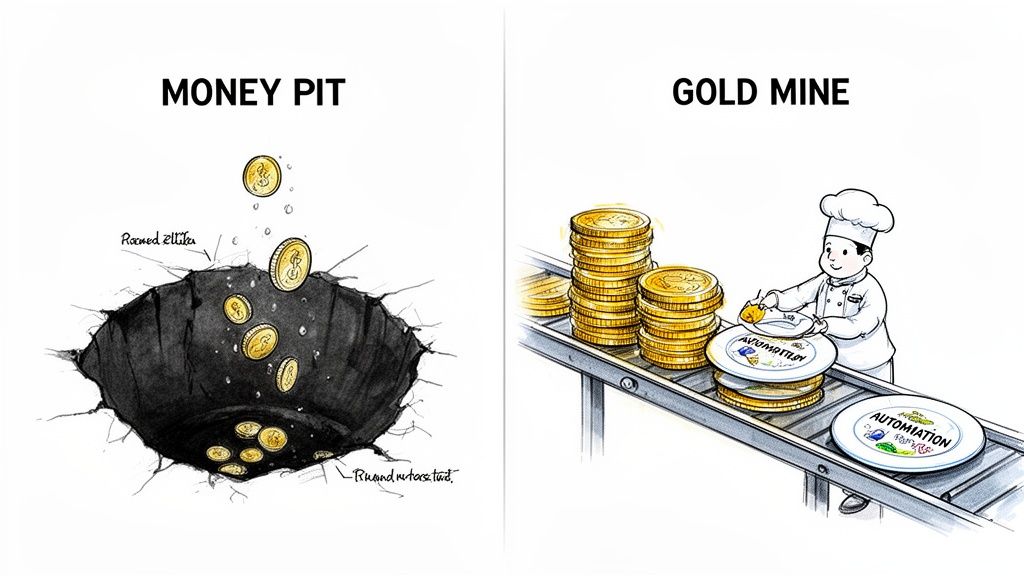
Let's try an analogy. Picture your marketing team as a group of incredibly talented chefs in a bustling restaurant. No matter how amazing they are, they can only cook so many personalized, gourmet meals at once. Eventually, they'll get swamped, orders will get mixed up, and the quality will start to tank. It's just human limitation.
Now, imagine an automated kitchen designed by those same expert chefs. It flawlessly prepares thousands of unique, perfectly timed meals simultaneously—never getting tired, never making a mistake. That’s exactly what marketing automation does. It delivers personalized experiences at a scale your human team could only dream of.
Why Calculating ROI Is an Absolute Must
Figuring out the ROI of your marketing automation isn't just a "nice-to-have" number for a slide deck. For any business that's serious about growth, it's non-negotiable. Without it, you're flying blind. You have no real way of knowing if your software is a money pit draining your budget or a gold mine actively minting new revenue.
When you consistently calculate ROI, you can:
- Justify your budget to the C-suite with cold, hard numbers.
- Pinpoint which campaigns are crushing it and which are duds.
- Make smart, data-driven tweaks to get even better results.
- Confidently ask for more resources to scale what's working.
The real magic of calculating ROI? It flips the script. Marketing stops being seen as a "cost center" and starts being recognized as a powerhouse revenue driver. It’s the ultimate proof you’re making a direct impact on the bottom line.
Laying the Groundwork for a Killer ROI
Before we jump into the formulas and number-crunching, let's get the foundation right. This isn’t about memorizing definitions; it’s about intuitively understanding how the work your team does every day connects to real financial outcomes.
To really see the difference, it's worth checking out a detailed CRM automation ROI comparison to see how it stacks up against the old-school, manual way of doing things. The contrast is often staggering.
Once you grasp the why behind the numbers, the how becomes a whole lot easier. This guide will walk you through it all, from the basic math to the clever tactics that will have you measuring—and maximizing—your returns like a pro.
The Simple Formula for Nailing Your Automation ROI
Alright, let's get down to brass tacks. You've heard the hype, you've seen the demos, but now it's time to answer the one question the CFO really cares about: "Is this marketing automation thing actually making us money?"
Figuring out the ROI might sound like you need a degree in advanced calculus, but it’s honestly not that complicated. The core idea is wrapped up in one simple, classic formula.
ROI = (Financial Gain – Investment Cost) / Investment Cost
That's it. To get the fancy percentage everyone loves, just multiply your result by 100. It's the same math you’d use to justify buying a new espresso machine for the office or a splashy billboard downtown. The real magic isn't in the formula itself, but in knowing what numbers to plug in.
Let’s break down the two sides of this equation.
What Exactly Is a "Financial Gain"?
This is the exciting part—where you get to count all the money and value your new automation machine is churning out. And trust me, it’s about a lot more than just the final cha-ching of a sale. It’s a mix of hard cash and some seriously valuable efficiency boosts.
Most of your financial gains will come from a few key places:
- More Dough from New Leads: This is the most obvious one. How much brand-new business can you trace back to the leads your automated funnels captured and wooed?
- Upsell & Cross-Sell Windfalls: Automation is brilliant at nudging existing customers with perfectly timed offers. Think "You might also like…" on steroids. It's a fantastic way to increase customer lifetime value without chasing new leads.
- Big Savings from Reclaimed Time: Imagine all the repetitive, soul-crushing tasks your team used to do manually. Now they're automated. Add up those saved hours, multiply by your team's hourly cost, and you'll uncover a massive "hidden" profit center.
The numbers here don’t lie. On average, companies generate a whopping $5.44 in revenue for every single dollar they put into marketing automation over three years. And you don't have to wait forever to see it, either. A solid 76% of companies see a positive ROI in the very first year.
What Goes into Your "Investment Cost"?
Now for the other side of the coin: what are you actually spending? To get a real, honest-to-goodness ROI, you have to look beyond the monthly subscription fee. A true calculation includes every single penny you put in.
Don't fall for the sticker price trap. A full cost picture includes the software fee, sure, but also the hours your team spends setting it all up, getting trained, and creating the content that feeds the machine. Getting this right is the secret to an ROI you can actually trust.
Here are the main costs you need to have on your radar:
- Software Subscription: This is the big, obvious one—the monthly or annual bill for your automation platform.
- Setup and Onboarding: Did you pay a one-time fee to get started? Or hire a consultant to get everything humming? That all counts.
- Content Creation: Every email, landing page, and social graphic takes time and resources to build. Don’t forget to factor that in.
- Team Time and Training: The hours your people spend learning the platform and running campaigns are a very real business cost.
This is where you can see the genius of adding something like visual automation to the mix. A tool like PixelPanda has its own subscription cost, sure. But it can slash your "Content Creation Costs" by automatically generating thousands of on-brand images.
This move simultaneously lowers your total investment and makes your campaigns more effective. It's a one-two punch that gives your final ROI a serious boost. You can see exactly how this would fit into your budget by checking out their clear pricing structure.
To really visualize how this all fits together, let's lay it out in a simple table.
Marketing Automation Cost vs Gain Breakdown
Here’s a simplified look at the buckets where your money goes (costs) and where it comes from (gains). Getting a handle on these components is the first step to a clear ROI calculation.
| Component | Investment (Costs) | Financial Gain (Revenue & Savings) |
|---|---|---|
| Technology | Monthly/Annual Software Subscription Fees | Increased Revenue from New Customers |
| Setup | One-Time Implementation & Onboarding Fees | Higher Upsell & Cross-Sell Revenue |
| People | Team Training & Ongoing Management Hours | Increased Customer Lifetime Value (LTV) |
| Content | Costs for Creating Emails, Ads, Visuals | Cost Savings from Staff Productivity |
| Consulting | Fees for Agencies or Freelance Experts | Reduced Customer Churn Rate |
By tracking both sides of this table, you stop guessing and start knowing. That simple formula we started with? It suddenly becomes your most powerful tool for proving just how much value marketing automation is driving for your business.
The Metrics That Actually Prove Your ROI
Alright, let's get real. Calculating the ROI of your marketing automation is one thing, but proving it to your boss—or yourself—means looking at the right numbers. Forget the vanity metrics. Likes and open rates are nice for a quick ego boost, but they don't keep the lights on.
To build a rock-solid case for your automation efforts, you need to tie your work directly to the cash register. We're talking about the KPIs that tell a story of real financial impact. It’s the difference between saying, "Hey, we got a ton of clicks!" and "Hey, we brought in $50,000 in new revenue."
This simple diagram breaks down the classic ROI formula, showing you exactly how your investment turns into a measurable gain.
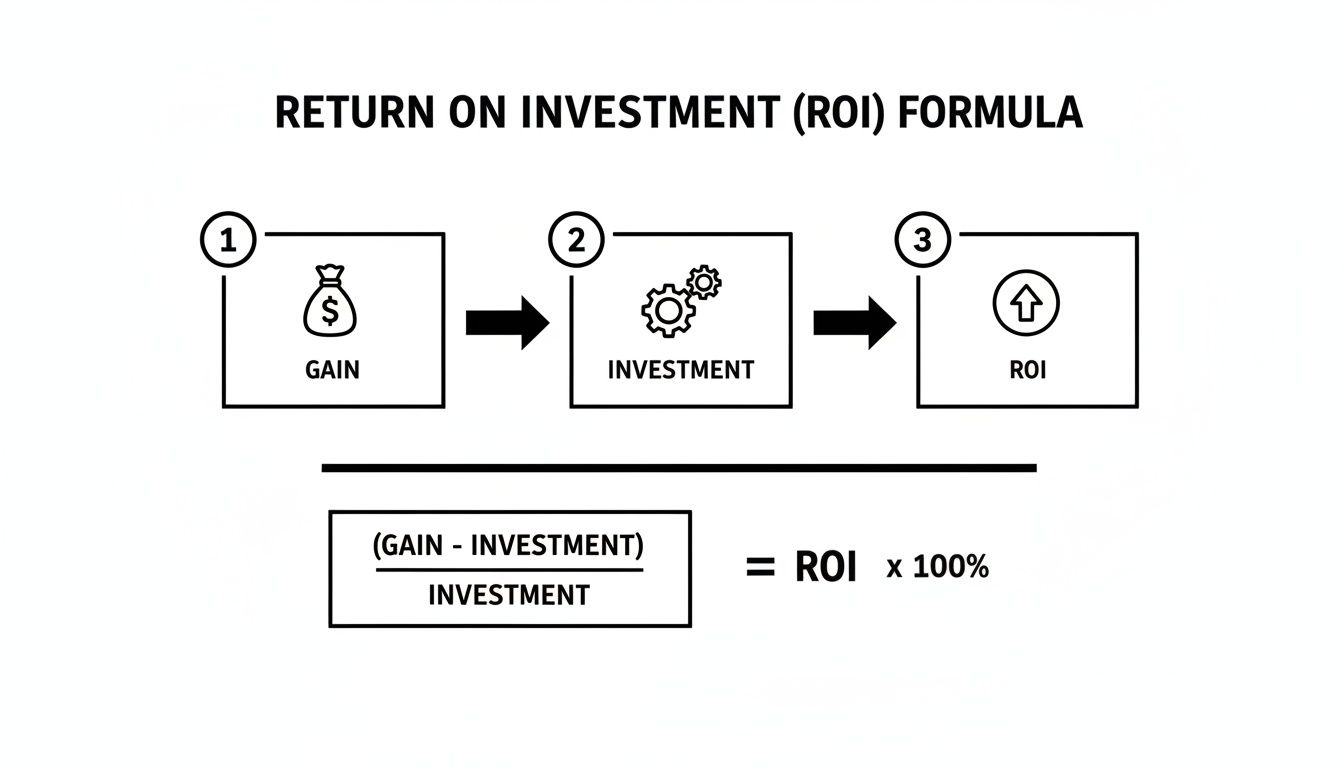
It’s pretty straightforward: ROI is what you get when you subtract the cost from the gains and see how that stacks up against what you originally spent.
Customer Acquisition Cost (CAC)
Think of Customer Acquisition Cost (CAC) as the price tag for winning over a new customer. How much did you spend in total on marketing and sales to get that one person to sign on the dotted line? You figure it out by dividing all those costs by the number of new customers you snagged in a certain period.
So, where does marketing automation fit in? It makes your entire acquisition game smarter and a whole lot cheaper. No more "spray and pray" marketing. Automation gives you laser-focused targeting and nurturing.
Here’s how automated workflows crush your CAC:
- They qualify leads for you, so your sales team isn't wasting time on tire-kickers. They only talk to people who are actually ready to buy.
- They warm up cold leads over time with personalized content, doing the heavy lifting until a lead is hot enough for sales to step in.
- They run A/B tests on autopilot, constantly tweaking your ads and landing pages to find the winning combo that lowers your cost per lead.
By putting these tasks on autopilot, you stop hemorrhaging money on wasted ad spend and cut down the people-power needed to close a deal. The result? A beautiful, shrinking CAC.
Customer Lifetime Value (CLV)
While CAC is about what it costs to get 'em, Customer Lifetime Value (CLV) is about how much they're worth once you've got 'em. This is the big prize. A high CLV means customers love you, stick around, and keep spending money, making them more and more profitable over time.
Marketing automation is an absolute beast when it comes to boosting CLV. It’s brilliant at building and maintaining relationships at a scale no human team could ever manage, turning one-time buyers into lifelong fans.
One study found that automated lead nurturing can lead to a jaw-dropping 451% increase in qualified leads. These aren't just names on a list; they're engaged prospects who are primed to become high-value, long-term customers.
For example, you can set up automated flows for:
- Welcoming new customers and showing them how to get the most value from your product right away.
- Upselling and cross-selling other cool stuff they might like, based on what they've already bought.
- Winning back old customers who've gone quiet with a tempting offer before they disappear for good.
Every single one of these automated touchpoints builds loyalty and keeps customers engaged, pumping up their lifetime value.
Lead-to-Customer Conversion Rate
This metric is the final report card for your entire funnel. The Lead-to-Customer Conversion Rate shows you what percentage of your leads actually become paying customers. If it’s low, you’ve got leaks. If it’s high, you’ve got a well-oiled machine.
Supercharging this conversion rate is what marketing automation was born to do. In fact, research shows businesses using automation see an average 77% jump in conversion rates. How? By creating a smooth, personal journey for every single prospect.
Picture this: a new lead signs up. Automation instantly scores them, sends them to the right salesperson, and kicks off a personalized welcome email series. As that lead interacts with your content, their score goes up, pinging the sales team that it's the perfect moment to call. It's a perfectly choreographed dance that makes sure no one falls through the cracks.
Keep a close eye on these three powerhouse metrics in your CRM and analytics, and you’ll have all the proof you need to show that your marketing automation ROI is more than just a number—it’s a massive win for the business.
Real-World Examples of Automation Driving Huge Returns
Theory is great, but let's be honest—the real "aha!" moment comes when you see marketing automation actually making money. Abstract formulas and KPIs are one thing, but watching them come to life with real dollars and cents is a whole different ballgame.
Let’s walk through a few scenarios that show just how powerful this stuff can be as an engine for growth and efficiency.
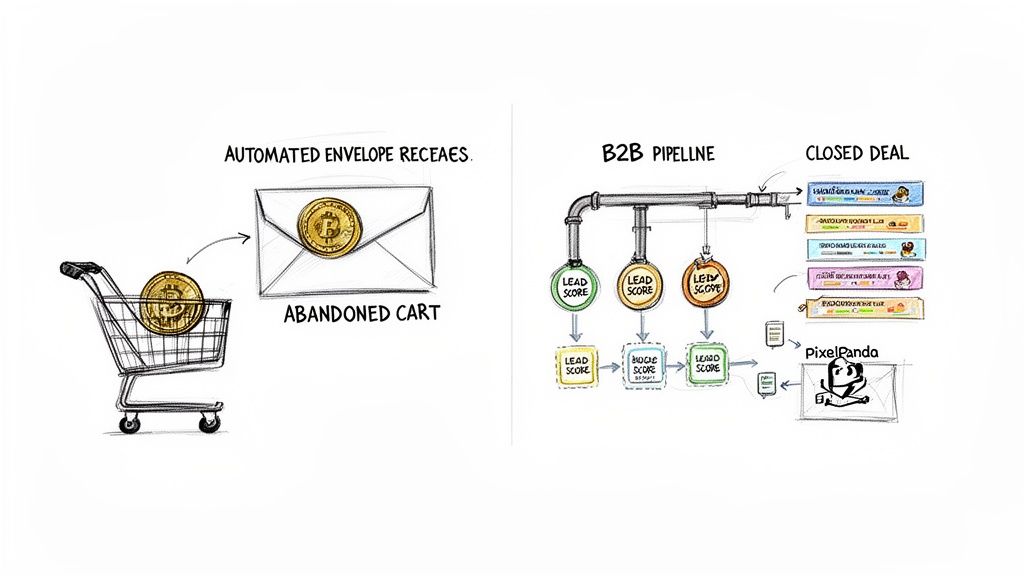
These aren’t just hypotheticals, either. They’re based on common, high-impact strategies that businesses are using every single day to turn their automation software from a neat tool into a serious money-making machine.
The Ecommerce Store Saving Sales on Autopilot
Picture an online store that sells custom pet portraits. They’re getting good traffic, but their abandoned cart rate is through the roof. For every ten people who start designing a portrait, seven bail before checking out. That’s a massive pile of almost-revenue just walking out the digital door.
Instead of hiring someone to chase down every single person, they set up a simple, three-step abandoned cart sequence:
- Email 1 (1 Hour Later): A friendly reminder pops up: "Did you forget something?" complete with a picture of the adorable pet portrait they were creating.
- Email 2 (24 Hours Later): A follow-up showcasing glowing customer testimonials and five-star reviews to build a little more trust.
- Email 3 (48 Hours Later): One final nudge with a small 10% discount to seal the deal.
This simple, automated sequence consistently recovers 20% of otherwise lost sales. If the store was losing $15,000 a month in abandoned carts, this automation now brings back $3,000 of that—every single month, with zero ongoing effort. That’s a direct, measurable lift you can take straight to the bank.
The B2B SaaS Company Shortening the Sales Cycle
Now, imagine a B2B software company with a long, complicated sales cycle. It used to take them an average of 90 days to turn a new lead into a paying customer. Their sales team was totally swamped, spending half their time chasing ghosts and the other half just trying to figure out who was actually interested.
They brought in a marketing automation platform with two game-changing features: lead scoring and automated drip campaigns.
- Lead Scoring: Every time a prospect hits the pricing page, downloads a whitepaper, or even opens an email, they get points. Once a lead hits a score of 100, they’re flagged as a "hot lead."
- Drip Campaigns: New, low-scoring leads are automatically entered into an educational email series. This sequence nurtures them with case studies and helpful tips over several weeks, warming them up without any manual work.
The impact here is huge. Businesses that use automation for lead nurturing see a stunning 451% increase in qualified leads. Not only that, but automation also contributes to a 77% increase in conversions, a stat you can dig into by reading the full research on its effectiveness.
So, what happened to our B2B company? Their sales team now only talks to prospects who have basically raised their hand and shown they’re ready. This simple shift cut their average sales cycle from 90 days down to just 60. That 30-day acceleration means cash comes in the door faster, which is a massive win for cash flow and overall revenue velocity.
Key Takeaway: Automation is a master at the patient, consistent follow-up that humans just can't scale. It warms up leads and hands them off at the perfect moment, making the entire sales process faster and way more effective.
Case Study: The Marketing Team Automating Visuals with PixelPanda
Finally, let's look at a marketing agency managing social media for 50 different clients. Every month, they need to crank out hundreds of unique, branded promotional banners for sales, events, and announcements. Their old workflow was a complete bottleneck—slow, expensive manual design work that was a recipe for inconsistency.
They decided to integrate the PixelPanda API into their workflow, building a system that completely transformed their process.
Now, their campaign manager just fills out a simple spreadsheet with the client's name, offer text, and a product image URL. The system takes that info, hits the API, and automatically generates a full set of perfectly branded banners for every social platform, all in a matter of seconds.
The results were immediate and massive:
- Cost Reduction: They slashed their monthly design outsourcing and freelance costs by an incredible 90%, saving thousands.
- Time Savings: A task that used to take days of back-and-forth with designers now takes less than five minutes. Seriously.
- Performance Boost: With the newfound ability to instantly test dozens of visual variations, they saw a 40% increase in average engagement across all their client campaigns.
This example is the perfect illustration of how the ROI of marketing automation isn't just about sending emails. By automating visual production, the agency drastically cut their investment costs while simultaneously boosting the financial gain from their campaigns. You can see this technology for yourself by playing around with some interactive PixelPanda demos.
How to Squeeze Every Last Drop of ROI from Your Automation (and Dodge the Classic Blunders)
Let's get one thing straight: buying a subscription to a fancy marketing automation platform doesn't magically print money. It’s like getting a top-of-the-line gym membership. You won't see results unless you actually show up, have a solid plan, and put in the work.
Success lives in your strategy, not just the software. To truly see the ROI of marketing automation soar, you have to move beyond basic email blasts and build a smart, responsive system that works for you 24/7. This is your field guide to not just getting a return, but absolutely crushing it.
Tactics to Send Your ROI Skyrocketing
Ready to graduate from just using automation to truly mastering it? The gap between a decent ROI and a spectacular one often comes down to a few key strategic moves. These aren't complicated tricks; they're proven methods for making your platform work harder and smarter for you.
Here’s where you start:
- Segment Like You Mean It: Stop carpet-bombing your entire list with the same message. Group your audience by their behavior, what they've bought before, or how engaged they are. A personalized offer to a loyal fan is a world away from a generic blast to everyone.
- A/B Test Everything. Seriously. Never assume you know what works. Test your email subject lines. Test your call-to-action buttons. Test your send times and landing page headlines. Tiny, continuous improvements stack up over time, leading to massive gains in your conversion rates.
- Connect Your Tech Stack: Your automation tool shouldn't be a lonely island. Hook it up to your CRM, your analytics platform, and other key business tools. This creates a seamless flow of data, giving you a crystal-clear picture of the customer journey and unlocking way more powerful automation triggers.
A critical mistake is seeing automation as a "one-and-done" task. The highest returns come from a mindset of constant tinkering and optimization. Your first workflow is just the starting line; the real magic happens when you refine it based on what real people are actually doing.
The ROI Killers You Absolutely Must Avoid
Knowing what not to do is just as important as knowing what to do. So many businesses watch their automation ROI fizzle out because they stumble into a few common traps. These pitfalls can turn a powerful growth engine into an expensive, dusty piece of software.
Avoiding them is mission-critical.
The marketing automation industry is exploding for a reason—it’s valued at $6.65 billion in 2024 and is projected to hit $15.62 billion by 2030. The tools work, but only if you sidestep these ROI-sabotaging mistakes.
Watch out for these classic blunders:
- The "Set It and Forget It" Mindset: Automation is not a crockpot. Launching a campaign and never looking at it again is a surefire way to send stale messages and miss golden opportunities. You have to get in there regularly, check the performance, and tweak your workflows.
- Running on Dirty Data: Garbage in, garbage out. Your automation is only as good as the data you feed it. Inaccurate contact info, missing fields, or messy lists lead to failed sends, cringe-worthy personalization attempts, and frustrated prospects. A regular data cleanup routine is non-negotiable.
- Sounding Like a Robot: The whole point of automation is to deliver personalization at scale, not to sound like a machine. If your emails lack a human touch and don't offer any real value, your audience will hit the unsubscribe button faster than you can say "workflow."
- Ignoring the Rest of the Funnel: Too many marketers pour all their automation energy into capturing new leads at the top of the funnel. Don't forget to build workflows for customer onboarding, upselling, and winning back old customers. That's where you'll find the gold in customer lifetime value. For a deeper dive on this, check out this excellent guide on how to maximize your marketing automation ROI.
A fantastic way to boost both personalization and efficiency is by automating your visual content. For teams looking to build this capability right into their own systems, exploring something like the PixelPanda developer API can open up powerful new ways to generate on-brand visuals automatically, cutting design costs and improving campaign performance all at once.
Your Burning Questions About Automation ROI, Answered
Jumping into marketing automation can feel like staring into the abyss, right? A lot of questions pop up, and they're usually the kind that keep you up at night. Let's get straight to it and tackle the big ones.
Think of this as the lightning round—no fluff, just the real-world answers you need.
How Long Until I Actually See a Positive ROI?
Ah, the million-dollar question. The honest answer is, "it depends," but that's not very helpful, is it? So let's get more specific. Think of it like planting a tree. A small business is like a fast-growing sapling; you could see a positive return in just 3-6 months. Your scale is smaller, so a few quick wins—like a killer welcome email series—can move the needle almost immediately.
For a mid-sized company, it’s more like planting a sturdy oak. You're looking at 6-12 months to get all the different branches (your departments) working together and see real growth. And for a massive enterprise? You're planting a whole forest. Integrating complex systems takes time, so it might be over a year before the full, powerful impact really shows.
Don't let that timeline scare you. A study found that a whopping 76% of companies see a positive ROI within the first year. The secret isn't your company's size; it's how well you plan and execute the rollout. A smart strategy always gets you there faster.
Is This Even Affordable for a Small Business?
Yes, it absolutely is. The idea that marketing automation is some exclusive club for giant corporations is a total myth. Today’s market is packed with platforms built to scale. You can start small with an entry-level plan that won't break the bank.
Here’s how small businesses can make it work without a huge budget:
- Start with Email: This is the low-hanging fruit. Set up an automated welcome series for new subscribers or a cart abandonment sequence for your e-commerce store. These are simple to build and deliver a return you can see almost instantly.
- Pick One Big Goal: Don't try to boil the ocean. Instead of automating everything at once, focus on a single, major pain point. Is it lead nurturing? Start there. Master it, prove its value, and then expand.
- Lean on Templates: Nearly every platform offers pre-built workflows and templates. Use them! They dramatically cut down your setup time and save you from having to hire an expert from day one.
The goal isn't to build a system as complex as a Fortune 500 company. It's to be scrappy and smart, using targeted automation to punch way above your weight.
What's the Single Biggest Mistake People Make When Measuring ROI?
I've seen it a hundred times: poor attribution. It’s like throwing a massive party and having no earthly idea which invitation actually brought people in the door. You could be running brilliant automated campaigns, but if you can’t connect them directly to a sale, your ROI calculation is just a wild guess.
This disaster usually happens when your marketing tools and your CRM aren't talking to each other. When that connection is broken, you can see a lead converted, but you have no clue why. You can't see the automated email they clicked, the webinar that got them interested, or the drip campaign that finally sealed the deal.
The fix? Get your tracking straight from day one. Make sure every link is trackable and that your systems are properly integrated to pass data back and forth. When you can draw a clean, straight line from a specific marketing action to a closed deal, your ROI stops being a guess and becomes undeniable proof of your success.
Ready to slash your content creation costs and boost your campaign performance? PixelPanda helps you automate visual production at scale, from social media banners to product images. See how it works at PixelPanda.